Cleveland
 Ship Overview
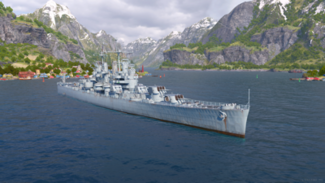
 Cleveland — American
• Tech Tree • Tier VII • Cruiser.
Cleveland — American
• Tech Tree • Tier VII • Cruiser.
A Cleveland-class cruiser. The ship had excellent AA capabilities and good armor protection for this type of ship. With all performance characteristics combined, she was one of the most powerful light cruisers of the World War II period.
 Navy: USN
Ship: American
Nation: United States
Category: Tech Tree
Tier: VII
Class: Cruiser XP: 210 000
Entered Service: 1942 Ships in Series: 28 Predecessor: Helena Successors: Seattle, Worcester Variants: AL Montpelier

Surgical Shells: A short shell fuse time results in lower chance of over-penetration.

Reloader: Above average main battery reload time.

Agile: Above average ability to change direction.
Ship Stats| SURVIVBILITY | STOCK | UPGRADED |
|---|---|---|
| • Hitpoints | 30 600 | 36 900 |
| • Armor (mm) | 13 - 165 | - |
| • Torpedo damage reduction (%) | 4 | 4 |
| MANEUVERABILITY | STOCK | UPGRADED |
|---|---|---|
| • Maximum speed (kt) | 33 | 33 |
| • Turning circle radius (m) | 660 | 660 |
| • Rudder-shift time (sec) | 9.3 | 7.2 |
| CONCEALMENT | STOCK | UPGRADED |
|---|---|---|
| • Detectability by sea (km) | 12.5 | - |
| • Detectability by air (km) | 7.5 | - |
| • Detectability while firing in smoke (km) | 6.1 | - |
| MAIN BATTERY | STOCK | UPGRADED |
|---|---|---|
| • Main artillery name | 152mm Mk16 | 152mm Mk16 mod. 1 |
| • Main artillery arrangement | 4x3 | 4x3 |
| • Firing range (km) | 13.9 | 15.3 |
| • Reload time (sec) | 7 | 6.5 |
| • 180° turn time (sec) | 18 | 20 |
| • HE maximum damage | 2200 | 2300 |
| • HE fire chance (%) | 12 | 13 |
| • HE penetration (mm) | 25 | 25 |
| • AP maximum damage | 3200 | 3300 |
| • Sigma | 2.0 | - |
| SECONDARY ARMAMENT 1 | STOCK | UPGRADED |
|---|---|---|
| • Name | 127mm Mk32 | 127mm Mk32 |
| • Arrangement | 6x2 | 6x2 |
| • Firing range (km) | 5 | 5 |
| • Reload time (sec) | 6 | 6 |
| • HE maximum damage | 1800 | 1800 |
| • HE fire chance (%) | 5 | 5 |
| • HE penetration (mm) | 21 | 21 |
| AA ARMAMENT 1 | STOCK | UPGRADED |
|---|---|---|
| • Name | 20mm Oerlikon Mk4 | 20mm Oerlikon Mk20 |
| • Arrangement | 23x1 | 23x2 |
| • DPS | 83 | 140 |
| • Range (km) | 2 | 2 |
| AA ARMAMENT 2 | STOCK | UPGRADED |
| • Name | 40mm Bofors Mk1 | 40mm Bofors Mk1 |
| • Arrangement | 10x2 | 6x2 |
| • DPS | 113 | 68 |
| • Range (km) | 3,5 | 3.5 |
| AA ARMAMENT 3 | STOCK | UPGRADED |
| • Name | 127mm Mk32 | 40mm Bofors Mk2 |
| • Arrangement | 6x2 | 4x4 |
| • DPS | 91 | 64 |
| • Range (km) | 5 | 3.5 |
Modules, Modifications & ConsumablesModules
Cruiser - Cleveland |
Hit Points | Min Armor (mm) | Max Armor (mm) | Torpedo Damage Reduction (%) | Main Battery Turrets | Rudder Shift (s) | Purchase Price |
|---|---|---|---|---|---|---|---|
| Stock | 30 600 | 13 | 165 | 4 | 4x3 | 9.3 | 0 |
| Hull B | 36 900 | 13 | 165 | 4 | 4x3 | 7.2 | 3 600 000 |
 |
Turret Arrangement | Reload Time (s) | 180° Turn Time (s) | Max HE Damage | HE Fire Chance (%) | Max AP Damage | Purchase Price |
|---|---|---|---|---|---|---|---|
| 152mm Mk16 | 4x3 | 7 | 18 | 2200 | 12 | 3200 | 0 |
| 152mm Mk16 mod. 1 | 4x3 | 6.5 | 20 | 2300 | 13 | 3300 | 450 000 |
 |
Firing Range Increase (%) | Main Battery Firing Range | Purchase Price |
|---|---|---|---|
| Stock | 0 % | 13.9 km | 0 |
| Targeting System: Mk7 mod. 2 | 10 % | 15.3 km | 450 000 |
 |
Maximum Speed |
|---|---|
| Stock | 33 kn |
Modifications
Cruiser - Cleveland| SLOT 1 |
|
|
|
|
||||||||||||
| SLOT 2 |
|
|
|
|||||||||||||
| SLOT 3 |
|
|
|
|
||||||||||||
| SLOT 4 |
|
|
|
|


Consumables
Cruiser - Cleveland
 |
| Accelerates repairs to damage modules, firefighting efforts and flooding recovery. |
|

 |
| Increases the guaranteed acquisition range of enemy ships and torpedoes, including those located within a smoke screen. |
|

 |
| Significantly increases guaranteed acquisition range of enemy ships, including those located within a smoke screen. |
|

 |
| Partially restores the ship's HP by repairing any light damage. |
|

|
| Increases the efficiency of AA fire. |
|

|
| Follows the ship and automatically attacks enemy aircraft. |
|
Community ContributionsPlayer Opinion
Cruiser - ClevelandPros:
- Citadel is deceptively difficult to penetrate properly from the sides, and can be over-penetrated easily.
- Solid main battery guns. Excellent rate of fire, firing range, shell penetration, and fire chance for HE shells.
- Favorable firing angles allow all four turrets to be used without showing excessive broadside.
- High shell arcs for lobbing over islands.
- Powerful anti-aircraft suite; can easily shoot down enemy strike craft without Defensive AA Fire

- Decent maneuverability.
Cons:
- Citadel is vulnerable to plunging fire.
- Light armor scheme means that Cleveland takes damage from incoming fire of nearly all calibers.
- Very prone to HE damage.
- Slow shell velocity and high arc; allows enemies time to maneuver and evade incoming fire.
- Medium-range anti-aircraft armament can be very easily destroyed by HE shells.
- No torpedoes.
- Low HP pool.
Performance
Changes
Cruiser - Cleveland- Stock main battery reload time increased from 6.5 s to 7 s
- Upgraded main battery reload time increased from 6 s to 6.5 s
History
Cruiser - ClevelandUSS Cleveland (CL-55) was an American Light cruiser, the first of her class and the first American light cruiser designed without the limitation of the inter-war treaties. Heavily based on the preceding Brooklyn class (represented in-game by the premium ship Boise), they exchanged one main battery turret for a better anti-aircraft armament, a bigger bridge, new radars and fire directors while keeping the respectable speed and armor of their predecessor. The Cleveland class was top-heavy, and the fitting of new anti-aerial weaponry and new electronics during the war made the situation worse. The desire to reduce the weight of the ships lead to the conception of the Fargo subclass, with smaller structure and better AA firing arcs. 52 Cleveland class vessels were ordered, but only 27 were completed. 13 were reordered as Fargo class ships (while only 2 were finished) and 9 were completed as Independence light carriers. Most of the class was decommissioned after their service in World War Two, but some were refitted as missile cruisers and served until the 80'. Only the USS Little Rock (CL-92, later CG-4) survived as a museum ship, in her missile cruiser configuration.
She received 13 battle stars during world war two for her service in the pacific.
Commissioned in 1942, Cleveland conducted her shakedown trial on the east coast of the USA, before being assigned to the Mediterranean for Operation Torch, the allied invasion of Vichy French North Africa. Deployed alongside USS Ranger (CV-4) , she provided air support, shore bombardment and anti-submarine duties before returning home for preparation to service in the Pacific.
Joining the Pacific in early 1943, Cleveland was assigned to the Cruiser Division 12 alongside her sister Columbia (CL-56) and Montpelier (CL-57) in the Task Force 18. Alongside the Task Force 69 (composed of two New Mexico and two Colorado class battleships), they took part in multiple patrol and AA screening in the Solomon Islands. At one point, the CruDiv 12 was reinforced with USS Denver (CL-58) and contributed to night bombardment. During one of those operations at Kula Gulf without Columbia, the division spotted on radar two Japanese ships and sent them to the bottom. After the engagement, the Task Force was assigned to a series of operations to secure the Solomon Islands chain. TF68 was renamed TG36.2 and took part in multiple shore bombardment operations and convoy escort, before being assigned in mid-1943 to the USS North Carolina (BB-65) screening. CruDiv 12 was deployed to cover two destroyers during their research for the survivor of the sunken light cruiser USS Helena (CL-50). In the summer of 1943, Cleveland was assigned to Task Force 39 after multiple patrol duties before being sent to Sydney, Australia, for repair. Resuming service to intercept the “Tokyo Express”, the Japanese supply chain of the Solomon Islands, she returned to Sydney for her first major break of the war. Cleveland took part in the invasion of the Bougainville Islands, procuring artillery support and AA cover. During the battle of Empress Augusta Bay, the CruDiv 12 engaged the Japanese light cruiser Sendai and the heavy cruiser Myōkō. Later the same night, the division suffered from an air attack from the Japanese carriers Zuikaku, Shōkaku and Zuihō. Only Montpelier was hit, by two bombs on one of her catapults, and the Task Force 39 claimed to have shot down 10 to 15 planes. After a last convoy escort, the ship was sent to Guadalcanal for rest : it was the first “calm” period of the CruDiv 12 after the formation of the division.
In early 1944, the Cleveland sisters took part in the New Guinea offensive, before Columbia left the division, letting only Cleveland and Montpelier to join Sydney for repair. Both cruisers took part in the invasion of Saipan, Tinian, and Guam, in the Mariana Islands before being assigned to the Task Group 58.3 of the TF58, composed mostly of fast carriers. Cleveland took part in the defense of the task group against more than a hundred of aircraft launched by three Japanese carriers : the engagement became known as the Great Mariana Turkey Shoot. Returning to Saipan, Cleveland resumed support duties, taking part in the invasion of Guam and Tinin before being reintegrated to CruDiv 12 alongside Denver and Montpelier. Columbia later joined the group for the invasion of Peleliu and Angaur Islands. Returning to the US for a complete overhaul in October, she stayed here until Christmas, receiving a new radar and fire control systems, and a modern Combat Information Center.
Returning to the Pacific in 1945, Cleveland joined CruDiv 12 again, minus Columbia, to support amphibious operations at Correligor and Bataan Peninsula, then Puerto Princessa and Palawan Island. Assigned to Task Group 95.2, the CruDiv 12 joined the CruDiv 16, composed of the two large cruisers of the Alaska class, to perform multiple patrols in China seas. Task Group 95.2 was at sea when Japan announced surrendering, and performed multiple exercises until the official surrender in Tōkyō Bay. After the surrender, she returned home for a massive overhaul.
After the war, Cleveland became a training ship, the CruDiv 12 being renamed CruDiv 14 and performing training cruises until mid-1946, when the four vessels of the CruDiv 14 were chosen for inactivation. Even if they were relatively recent ships, the war refits for more AA and new electronics aggravated the weight issues. Cleveland was decommissioned in 1947, stricken from the Navy list in 1959 and sold for scrap in 1960.
In World of Warships Legends, USS Cleveland is represented in her early and late war configurations. However, her fighter is a Grumman F3F, which never had a floatplane variant and wears pre-war markings.
Source:
Content Links
