Graf Zeppelin
| <span title="Graf Zeppelin (< 23.01.2019)" class="commentDrop" height="22">[[File:Graf Zeppelin (< 23.01.2019)_icon_small.png|link=]]</span> | |||||||||||
Purchase price13 700 
|
| Hit Points52 600 |
| 150 mm L/55 MLC/368 х 2 pcs. |
| Firing Range6.25 km. |
| Rate of Fire8 shots/min. |
| Reload Time7.5 sec. |
| HE Shell150 mm Spr.Gr. L/4.5 |
| Maximum HE Shell Damage1700 |
| Initial HE Shell Velocity875 m./s. |
| Chance of Fire on Target Caused by HE Shel8 % |
| 105 mm L/65 Dop. L. C/316 х 2 pcs. |
| Firing Range6.25 km. |
| Rate of Fire17.91 shots/min. |
| Reload Time3.35 sec. |
| HE Shell105 mm Spr.Gr. Kz. |
| Maximum HE Shell Damage1200 |
| Initial HE Shell Velocity900 m./s. |
| Chance of Fire on Target Caused by HE Shel5 % |
| 37 mm Flak LM/4211 х 2 pcs. |
| . . . Average Damage per Second113.3 |
| . . . Firing Range3.51 km. |
| 20 mm Flakvierling 387 х 4 pcs. |
| . . . Average Damage per Second44.8 |
| . . . Firing Range2.01 km. |
| 105 mm L/65 Dop. L. C/316 х 2 pcs. |
| . . . Average Damage per Second99.6 |
| . . . Firing Range4.5 km. |
| Maximum Speed32 knot |
| Turning Circle Radius1 140 m. |
| Rudder Shift Time13.7 sec. |
| Surface Detectability Range16.2 km. |
| Air Detectability Range13.83 km. |
| <span title="Graf Zeppelin (< 23.01.2019)" class="commentDrop" height="22">[[File:Graf Zeppelin (< 23.01.2019)_icon_small.png|link=]]</span> | |||||||||||
| Purchase price13 700
|
| Hit Points52 600 |
| 150 mm L/55 MLC/368 х 2 pcs. |
| Firing Range6.25 km. |
| Rate of Fire8 shots/min. |
| Reload Time7.5 sec. |
| HE Shell150 mm Spr.Gr. L/4.5 |
| Maximum HE Shell Damage1700 |
| Initial HE Shell Velocity875 m./s. |
| Chance of Fire on Target Caused by HE Shel8 % |
| 105 mm L/65 Dop. L. C/316 х 2 pcs. |
| Firing Range6.25 km. |
| Rate of Fire17.91 shots/min. |
| Reload Time3.35 sec. |
| HE Shell105 mm Spr.Gr. Kz. |
| Maximum HE Shell Damage1200 |
| Initial HE Shell Velocity900 m./s. |
| Chance of Fire on Target Caused by HE Shel5 % |
| 37 mm Flak LM/4211 х 2 pcs. |
| . . . Average Damage per Second113.3 |
| . . . Firing Range3.51 km. |
| 20 mm Flakvierling 387 х 4 pcs. |
| . . . Average Damage per Second44.8 |
| . . . Firing Range2.01 km. |
| 105 mm L/65 Dop. L. C/316 х 2 pcs. |
| . . . Average Damage per Second99.6 |
| . . . Firing Range4.5 km. |
| Maximum Speed32 knot |
| Turning Circle Radius1 140 m. |
| Rudder Shift Time13.7 sec. |
| Surface Detectability Range16.2 km. |
| Air Detectability Range13.83 km. |

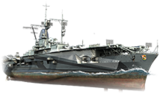
[[Ship:Graf Zeppelin (< 23.01.2019)|Graf Zeppelin (< 23.01.2019)]] — German Tier VIII aircraft сarrier.
A high-speed aircraft carrier armed with numerous secondary and dual-purpose guns. She had the most powerful propulsion among all German Navy ships. The carrier was never completed because Germany's shipbuilding program priorities changed during the course of World War II.
Modules
 |
Hit Points (HP) | Armor (mm) | Armor (mm) | Main Turrets (pcs.) | Secondary Gun Turrets (pcs.) | AA Mounts (pcs.) | Torpedo Tubes (pcs.) | Hangar Capacity (pcs.) |
Research price (exp) |
Purchase price ( ) | |
|---|---|---|---|---|---|---|---|---|---|---|---|
| Graf Zeppelin | 52 600 | 9 | 100 | 6/8 | 7/11/6 | 0 | 0 |
 |
Cruise Speed (knot) | Average Damage per Second (HP/min) | Loadout | Hit Points (HP) |
Research price (exp) |
Purchase price ( ) | |
|---|---|---|---|---|---|---|---|
| Bf 109T | 136 | 1320 | 0 | 0 |
 |
Maximum Torpedo Damage (HP) | Cruise Speed (knot) | Hit Points (HP) |
Research price (exp) |
Purchase price ( ) | |
|---|---|---|---|---|---|---|
| Ju 87C | 10 500 | 135 | 16 | 0 | 0 | |
| Ju 87C | 10 500 | 135 | 16 | 0 | 0 |
 |
Maximum Bomb Damage (HP) | Cruise Speed (knot) | Hit Points (HP) |
Research price (exp) |
Purchase price ( ) | |
|---|---|---|---|---|---|---|
| Ju 87C | 135 | 16 | 0 | 0 | ||
| Ju 87C | 135 | 16 | 0 | 0 |
 |
Maximum Speed (knot) |
Research price (exp) |
Purchase price ( ) | |
|---|---|---|---|---|
| Propulsión: 200 000 CV | 32 | 0 | 0 |
Compatible Upgrades
Player Opinion
Performance
Though never fully finished in real life, Graf Zeppelin comes alive in World of Warships as the first carrier to enter the game from a nation other than Japan or America.
As a Tier VIII carrier, Graf Zeppelin will inevitably face powerful AA ships such as Tier X cruisers Des Moines and Minotaur and will be forced to evade or work around these ships to attack with her bombers. Her planes can be quickly and easily shot down by ships that are built for anti-air; however, they are very fast and can strike swiftly before the enemy has a chance to knock down many of the planes. In short, the plane durability is very much akin to its Tier VIII Japanese counterpart Shokaku. Where Zeppelin differs significantly is its ability to choose between AP & HE bombs for its dive bombers, though — as with Enterprise — this choice must be made before queuing for a battle.
The HE bombs, like high-tier American dive bombs, pack quite a punch against cruisers and destroyers, while the AP bombs are devastating towards battleships and cruisers with thick enough deck armor (especially German battleships). Furthermore, as there is a somewhat large reserve of the bombers, captains can afford to sacrifice some planes to attack certain strategically positioned targets. However, captains must be careful of losing entire squadrons as the respawn time for a lost squadron is quite long. A word of additional warning on the AP bombs: they have a very long drop sequence that makes them difficult to land against maneuvering targets. Manual drops are all but impossible, and auto-drops frequently yield sub par results. As of Update 0.6.9.1, only the high explosive bombs are truly viable for use against enemy ships who are awake and at the keyboard.
Graf Zeppelin’s fighters have sufficient firepower to reliably strafe down enemy planes. With that said, captains should work to avoid being forced into dogfights with other enemy squadrons if possible, as the fighters will easily lose to straight up dogfights with other enemy fighters at Tier VIII due to their low average DPS. While the fighters are relatively fast like Shokaku’s Kawanishis, their average DPS and HP are much lower, making dogfights with any same tier fighter squad virtually a guaranteed loss. Even attempting to dogfight with Enterprise's Tier VII Hellcat fighters will likely result in a loss, as the squads are slightly larger (by one plane) and have similar average DPS and HP, while being a tier lower and able to utilize Dogfighting Expert against them. Because of this, the Graf Zeppelin's Messerschmitts are effectively the worst fighters for her tier. Additionally, there is a much smaller reserve of fighters compared to the bombers, so utilizing the fighters to their utmost before one loses all of them is difficult, and the player can easily be left with just bombers remaining.Pros:
- Ability to choose between AP and HE bombs.
- Balanced loadout with both fighters and attack planes.
- Secondary armament provides decent protection from close-in destroyers.
- AP bombs can devastate enemy battleships, cruisers, and carriers.
- Adequate anti-aircraft suite for self-defense.
Cons:
- Unable to switch bomb types mid battle, which can leave the player helpless against certain enemy team compositions.
- As a Tier VIII aircraft carrier, captains may face off against large amounts of high tier AA.
- Unable to train captains for any other carriers, and requires a specialized German captain to perform well.
- No torpedo bombers, making it very difficult to deal with enemy destroyers effectively.
- Poor base surface detectability range at 16.2km.
- Has weak fighters compared to other Tier VIII carriers.
- AP bombs are nearly impossible to land hits with, even when auto-dropped.
Research
Optimal Configuration
Upgrades
The recommended upgrades for Graf Zeppelin are as follows:
- Slot 1: Air Groups Modification 1*
- Slot 2: Air Groups Modification 2*
- Slot 4: Damage Control System Modification 1
- Slot 5: Damage Control System Modification 2
- Slot 6: Concealment System Modification 1
Upgrade Slot 1 provides two viable options. Air Groups Modification 1 is highly recommended to improve her weak fighters, but some players may choose to specialize in anti-aircraft duties or the secondary battery to defend against attacking aircraft and ships. For either specialization, Auxiliary Armaments Modification 1 should be equipped.
Upgrade Slot 2 provides options for different roles and specializations. Air Groups Modification 2 is highly recommended to increase the ammunition and hit points (HP) of fighter aircraft. Some players may choose to mount Flight Control Modification 1 in order to get planes airborne faster. For specialization in anti aircraft duties or the secondary battery, either AA Guns Modification 2 or Secondary Battery Modification 2 should be mounted, depending on the desired specialization.
Commander Skills
Graf Zeppelin is in a unique position as far as her Commander Skills go. While she is an aircraft carrier, she does not have any Torpedo Bombers. This means that commander skills strictly meant for the improvement of Torpedoes Bombers can be forgone, leaving space for other skills. In addition, the Graf Zeppelin features a fearsome secondary armament sure to surprise any ships that venture too close in the hopes of an easy kill. So, choosing Commander Skills that increase the performance of her secondaries is certainly a viable way to go.
Recommended Commander Skills 
| ||||||||
|---|---|---|---|---|---|---|---|---|
| Cost (points) |
Endurance | Attack | Support | Versatility | ||||
| 1 |
 Priority Target
|
 Preventative Maintenance
|
 Expert Loader
|
 Aircraft Servicing Expert ★★ |
 Direction Center for Catapult Aircraft
|
 Dogfighting Expert ★★★ |
 Incoming Fire Alert
|
 Evasive Maneuver ★ |
| 2 |
 High Alert ★ |
 Jack of All Trades ★ |
 Expert Marksman
|
 Torpedo Acceleration
|
 Smoke Screen Expert
|
 Expert Rear Gunner ★★ |
 Adrenaline Rush
|
 Last Stand
|
| 3 |
 Basics of Survivability
|
 Survivability Expert ★ |
 Torpedo Armament Expertise
|
 Emergency Takeoff ★★★ |
 Basic Firing Training ★★ |
 Superintendent
|
 Demolition Expert
|
 Vigilance
|
| 4 |
 Manual Fire Control for Secondary Armament ★★ |
 Fire Prevention
|
 Inertia Fuse for HE Shells
|
 Air Supremacy ★★★ |
 Advanced Firing Training ★★ |
 Manual Fire Control for AA Armament
|
 Radio Position Finding
|
 Concealment Expert ★★ |
| Key: ★★★ - Extremely Useful ★★ - Frequently Useful ★ - Occasionally Useful No stars - Not Useful | ||||||||
Consumables
Graf Zeppelin features two consumables: Damage Control Party ( ) and Defensive AA Fire (Plantilla:Defensive AA Fire 1). The premium version of Damage Control Party (Plantilla:Damage Control Party 2) may prove useful if one tries to take advantage of Graf Zeppelin’s secondary battery guns, while Defensive AA Fire II (Plantilla:Defensive AA Fire 2) may be useful if one finds themselves subjected to repeated attacks by the enemy carrier.
Camouflage
As a premium ship, Graf Zeppelin comes included with Type 10 camouflage that lowers her detection radius, reduces the accuracy of incoming shells, and increases the amount of experience she earns.
Signals
As a premium aircraft carrier, Graf Zeppelin can mount only four signal flags simultaneously. Captains using high explosive bombs should mount India X-Ray and Victor Lima flags for a boost to their fire chance. November Echo Setteseven flags are recommended to boost the ship’s anti-aircraft damage. Captains can also mount November Foxtrot and India Yankee flags for increased survivability. Lastly, economic and special flags can be used to increase the ship’s credit and experience gain per battle.
Recommended Signal Flags 
| |||||
|---|---|---|---|---|---|
| Combat | |||||
 November Echo Setteseven ★★ |
 Mike Yankee Soxisix ★ |
 India X-Ray ★★★ |
 Juliet Whiskey Unaone
|
 Victor Lima ★★★ |
 Hotel Yankee
|
 November Foxtrot ★★ |
 Sierra Mike ★ |
 India Delta
|
 Juliet Yankee Bissotwo ★ |
 India Yankee ★★ |
 Juliet Charlie
|
| Economic | |||||
 Zulu ★★ |
 India Bravo Terrathree ★ |
 Equal Speed Charlie London ★★★ |
 Zulu Hotel ★ |
 Papa Papa ★★ | |
| Special | |||||
 Wyvern ★★★ |
 Red Dragon ★★ |
 Dragon Flag ★ |
 Ouroboros ★★ |
 Hydra ★★ | |
| Key: ★★★ - Extremely Useful ★★ - Frequently Useful ★ - Occasionally Useful No stars - Not Useful | |||||
Gallery
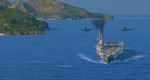
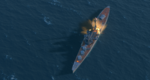
An AP bomb from Graf Zeppelin's air wing finds the Mogami's citadel.
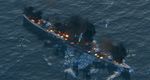
A German dive bomber returns to base after dropping its' ordinance on an enemy Yamato.


Historical Info
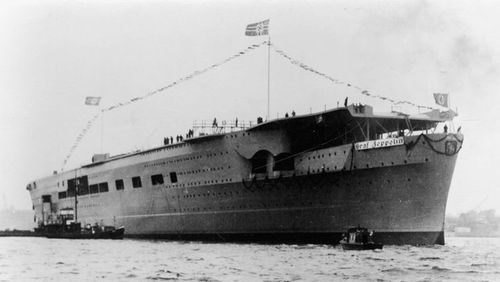
Graf Zeppelin, 1939
Construction
- Deutsche Werke; Kiel, Germany
- Laid down: 28 December 1936
- Launched: 8 December 1938
Specifications
- Displacement: 28,090 tons, standard
- Length: 250.00m
- Beam: 31.50m
- Draft: 7.20m
Machinery
- 16 La Mont boilers, 4 Brown-Boveri turbines
Performance
- 33 knots at 200,000 shaft horsepower
- 8,000 nautical miles at 19 knots
Armor
- Main belt: 60-100mm
- Flight deck: 20-45mm
- Torpedo bulkhead: 20mm
- Armoured deck: 40-60mm
- Transverse bulkheads: 60-80mm
- Casemates: 20-30mm
- Superstructure: 17mm
Armament
Secondary
- 16 (8 x 2) 150mm/55 C28 low-angle guns
- 12 (6 x 2) 105mm/65 C33 high-angle guns
Anti-Aircraft
- 22 (11 x 2) 37mm/83 C33 guns
- 7 (7 x 1) 20mm/115 C30 guns
Aircraft
Total
- 42 aircraft
- 2 compressed-air catapults
Fighters
- Twelve (12) Bf 109T
Bombers
- Thirty (30) Ju 87C
Complement
- 1,760 men (est.)
Design History
Flugzeugträger A — later christened Graf Zeppelin — was the culmination of the efforts mustered by the German Armed Forces to produce a native aircraft carrier to field in their reborn navy. The endeavor started in 1933, when the Kriegsmarine first seriously considered building a carrier; due to the circumstances Germany found herself in following World War I, there was a notable gap between her naval aviation capabilities and those of other navies. The project was further made difficult as aircraft technologies were rapidly shifting during the 1930s, and because — more inherently — the Kriegsmarine did not have any carrier doctrine to speak of. The Luftwaffe — a contributor to this joint venture — was also unenthusiastic, as they did not have any planes to spare for the Navy, nor did they have experienced pilots in naval aviation. Regardless, by 1934 the Kreigsmarine drafted the first designs and handed them over to Deutsche-Werke AG to finalize plans and begin construction.
The proposal by the Kriegsmarine called for a ship of 22,000 tons that could make 35 knots speed and carry 50 planes. In accordance with the Anglo-German Naval Agreement, two ships of such size would keep them below 50 percent of British carrier tonnage.
Since many resources were being invested in project, the Kriegsmarine was keen to ensure the survivability of the vessels. Uncharacteristic of typical German ships of this size, she was divided into multiple narrow compartments to mitigate loss to flooding. Also uncharacteristic of most carriers, she had armor installed, roughly equal to that of a cruiser. Additionally, Graf Zeppelin had a very novel system installed for fire-suppression: all the fuel systems were buffered with pressurized gasses. The non-liquid systems were filled with dry gas, and pipes carrying petroleum were jacketed with tubing filled with inert gas. Graf Zeppelin also had torpedo bulges installed for better protection and weight balance late in the design phase.
To reach the top speed wanted in the design sketches, engineers concluded that it would require an engine output of over 200,000 shaft horsepower; no ship in built by the navies Europe had that much power at the time. To accomplish such a feat, engineers estimated that it would take no less than four turbines to do so, with each turbine being fed by four boilers. Each group of boilers would be placed in their own fire-room for better management. In addition, a novel feature implemented into Graf Zeppelin was the Voith-Schneider cyclorotors. Designers understood that a vessel of such size would not be able to maneuver on rudder alone in ports and canals. Accordingly, they installed two cyclorotors under the forward keel of the ship; they could be extended in order to aid in low-speed maneuverability, and then retracted back into the hull when not in use. (In modern vessels, bow thrusters fill a similar role.) Similarly, in 1939, her straight bow was replaced by a “clipper” bow to increase seaworthiness.
Just like the navies of America and the Japan, the German Kriegsmarine fell into the belief that aircraft carriers should be able to protect themselves in surface combat. As such — in conjunction with her aforementioned armor package — Graf Zeppelin mounted sixteen 150mm guns in eight twin-armored casemates all along her bow. Since these guns could only service low-angles, she had another twelve 105mm guns installed in six twin-turrets fore-and-aft of the island superstructure. In addition, she had a complement of 20mm and 37mm anti-aircraft guns.
Unlike aircraft carriers of other nations, planes could not take off from the flight deck unassisted; they had to be launched off two prominent steam pressure catapults built into the forward end of the flight deck. As the catapults used large launching sleds to hurl the aircraft off deck, there was a complex retrieval system built right underneath the flight deck to re-position the sleds back at the start for reuse. In theory, this allowed the aircraft carrier to launch eight planes in under four minutes. The catapults would be fed via three elevators that worked between two hangars. As German aviation programs could not diversify for both Air force and Navy needs, the mainstay of the aviation complement onboard Graf Zeppelin would be naval versions of the Messerschmitt Bf 109 fighter and the Junkers Ju 87 dive-bomber.
Service History
Despite all the efforts put into her design and construction, Graf Zeppelin would never come into being as the first completed aircraft carrier of the Axis powers of Europe. Finally laid down in 1937 — following the Anglo-German Naval Treaty of 1935 where Germany successfully negotiated for the right to build aircraft carriers — the fate of Graf Zeppelin and her unnamed sister ship would be argued over by three men: Grand Admiral of the Kriegsmarine Erich Raeder, head of the Luftwaffe Hermann Göring, and Admiral Karl Dönitz. Raeder was the driving force behind the addition of aircraft carriers to the Kriegsmarine, following visitations to see Japan’s powerful carrier force earlier in the 1930’s. An aircraft carrier would require aircraft, however, and this would require an establishment of a Fleet Air Arm, leading to the short-lived Trägergruppe (or "Carrier Group"). This, however, would be under the split jurisdiction of the Kriegsmarine and the Luftwaffe, and Göring jealously fought off any attempts that would undermine his complete control of every military aircraft Germany carried. Dönitz, an influential admiral himself, knew that the greatest successes enjoyed by the Kaiserliche Marine was at the hands of their U-boats, and believed that Germany could never muster a naval force to contest the Royal Navy on the surface; he pushed to have resources that would be expended on any aircraft carriers shifted elsewhere.
Given all of the various factors involved, Raeder’s ambitions of adding a total of four aircraft carriers to the Kriegsmarine would ultimately prove impossible. Nevertheless, construction of Graf Zeppelin and her sister Flugzeugträger B proceeded uninterrupted until the outbreak of World War II in 1939, halting construction as wartime resources were spent elsewhere (and Raeder still battled Göring politically). In late February 1940, the frustrated Raeder ordered Flugzeugträger B to be broken up and scrapped, although Graf Zeppelin was spared this fate, rusting in a drydock at Kiel. Her sixteen 150mm secondaries were transferred to coastal installations in recently conquered Norway in April 1940 with Hitler’s approval. She first went to sea in July 1940 to be transferred to Gotenhafen, Germany where she continued to languish in port without any progress. She moved again to Stettin in November 1941 to stay out of Russian air strike range, where she was used as a floating warehouse by the Kriegsmarine. Following the successful Japanese carrier strike on Pearl Harbor, Raeder had the ammunition to finally gain approval from Hitler to continue construction on Graf Zeppelin in May 1942. Construction continued slowly from then on, moving back to a floating drydock in Kiel come December 1942. In late January 1943, however, Hitler had become disenchanted with the Kriegsmarine and ordered all large surface ships to be scrapped. In the political chaos that followed, Raeder was relieved as the head of the Kriegsmarine by Dönitz. Dönitz managed to convince Hitler to withdraw his order to scrap most surface ships, but agreed to halt the construction of all large capital ships. Thus, in February 1943 Graf Zeppelin’s construction was halted for the last time. In April, she was towed to a wharf near Stettin, where she sat for two years with a 40-man skeleton crew.
In April 1945, as Soviet forces drew near, her crew flooded and detonated the ship in port, bringing an end to Germany’s only purpose-built aircraft carrier to ever near completion. Her life was not yet over, however. In March 1946, in violation of agreements with the Allied powers, Russia re-floated Graf Zeppelin. She was towed out of Stettin in the summer of 1947 — believed to be headed for the Soviet Union — with her flight deck loaded with containers. What happened after this point is not fully known. Western historians state that she struck a mine off the Gulf of Finland, and was scrapped after her damaged wreck was dragged to Leningrad. Soviet records indicate that she briefly made port in Swinemunde, then was towed out of harbor on 16 August 1947 and used as a target hulk for bombs, shells, and torpedoes. In 2006, her wreckage was discovered in 80 meters of water north of Władysławowo, Poland, confirming the final resting place of the Kriegsmarine's lone aircraft carrier.Historical Gallery
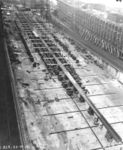
The keel for Graf Zeppelin in December 1936.
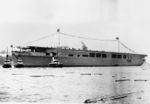
Graf Zeppelin after her launching on 8 December 1938.
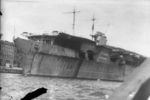
Graf Zeppelin moored at Stettin in mid-1941.
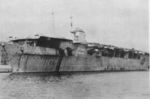
Another view of Graf Zeppelin in 1941.
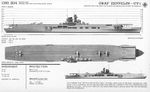
Projected recognition drawing of Graf Zeppelin had she been completed in September 1942.
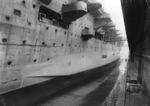
Graf Zeppelin in drydock in March 1943.
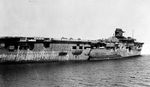
Graf Zeppelin in 1947 at Swinemunde, prior to her sinking as a target ship.
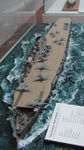
Bow view of a model of Graf Zeppelin, at the Aeronauticum.


References
- Chesneau, R., Gardiner, R. (1980). Conway’s All the World’s Fighting Ships: 1922-1946. London UK: Conway Maritime Press.
- Breyer, S. (1989). Graf Zeppelin: The German Aircraft Carrier. West Chester. PA: Schiffer Publishing Ltd.
| N/A | |
| U.S.A. | IV [[Ship:Langley (< 23.01.2019)|Langley (< 23.01.2019)]] • IV Langley • V [[Ship:Bogue (< 23.01.2019)|Bogue (< 23.01.2019)]] • VI [[Ship:Independence (< 23.01.2019)|Independence (< 23.01.2019)]] • VI Independence • VI Ranger • VII [[Ship:Ranger (< 23.01.2019)|Ranger (< 23.01.2019)]] • VII [[Ship:Saipan (< 23.01.2019)|Saipan (< 23.01.2019)]] • VIII [[Ship:Lexington (< 23.01.2019)|Lexington (< 23.01.2019)]] • VIII Yorktown • VIII Lexington • VIII [[Ship:Enterprise (< 23.01.2019)|Enterprise (< 23.01.2019)]] • VIII Enterprise • VIII Saipan • VIII Hornet • VIII Saipan B • VIII AL Hornet • IX [[Ship:Essex (< 23.01.2019)|Essex (< 23.01.2019)]] • X [[Ship:Midway (< 23.01.2019)|Midway (< 23.01.2019)]] • X Essex • X Midway • X Franklin D. Roosevelt • X [[Ship:[Midway]|[Midway]]] • United States • VIII Saipan • VIII Hornet • VIII Saipan B • VIII AL Hornet • IX [[Ship:Essex (< 23.01.2019)|Essex (< 23.01.2019)]] • X [[Ship:Midway (< 23.01.2019)|Midway (< 23.01.2019)]] • X Essex • X Midway • X Franklin D. Roosevelt • X [[Ship:[Midway]|[Midway]]] • United States
|
| Commonwealth | |
| N/A | |
| Germany | IV Rhein • VI Weser • VI Erich Loewenhardt • VIII August von Parseval • VIII [[Ship:Graf Zeppelin (< 23.01.2019)|Graf Zeppelin (< 23.01.2019)]] • VIII Graf Zeppelin • VIII Graf Zeppelin B • X Manfred von Richthofen • X Werner Voss • X Max Immelmann • X Otto Lilienthal
|
| U.S.S.R. | IV Komsomolets • VI Serov • VIII Pobeda • VIII Chkalov • VIII Chkalov B • X Admiral Nakhimov • X Admiral Orlov
|
| Italy | VIII Aquila
|
| N/A | |
| Japan | IV [[Ship:Hōshō (< 23.01.2019)|Hōshō (< 23.01.2019)]] • IV Hōshō • V [[Ship:Zuihō (< 23.01.2019)|Zuihō (< 23.01.2019)]] • VI [[Ship:Ryūjō (< 23.01.2019)|Ryūjō (< 23.01.2019)]] • VI Ryūjō • VII [[Ship:Hiryū (< 23.01.2019)|Hiryū (< 23.01.2019)]] • VII [[Ship:Kaga (< 23.01.2019)|Kaga (< 23.01.2019)]] • VIII [[Ship:Shōkaku (< 23.01.2019)|Shōkaku (< 23.01.2019)]] • VIII Shōkaku • VIII Kaga • VIII Kaga B • IX [[Ship:Taihō (< 23.01.2019)|Taihō (< 23.01.2019)]] • X [[Ship:Hakuryū (< 23.01.2019)|Hakuryū (< 23.01.2019)]] • X Hakuryū • X Shinano • X [[Ship:[Hakuryū]|[Hakuryū]]] • Sekiryu
|
| U.K. | IV Hermes • VI Furious • VI Ark Royal • VIII Implacable • VIII Indomitable • VIII Colossus • VIII Theseus • X Audacious • X Malta • X [[Ship:[Audacious]|[Audacious]]] • Eagle
|
| France | VI Béarn
|
| Pan-Asia | VIII Sanzang
|
| N/A |
- Esta página fue modificada por última vez el 25 ago 2017, a las 15:45.
- Esta página se ha visitado 188 veces.
© 2011–2026 Wargaming.net. Todos los derechos reservados.
