User:SirDixie:eu/moretesting
Contents
County Class Cruiser
The County class was a class of heavy cruisers built for the Royal Navy in the years between the First and Second World Wars. They were designed within the limits of the Washington Naval Treaty of 1922. Such ships, with a limit of 10,000 tons standard displacement and 8-inch calibre main guns may be referred to as "treaty cruisers".
Thirteen County class ships were built in Kent, London and Norfolk sub-classes. They were the only 10,000-ton 8-inch gun, or "A", cruisers that the Royal Navy built. The Counties are remembered for their distinctive three-funnel layout and service in all the major naval theatres of the Second World War. They were designed for overseas service in peacetime and for hunting down commerce raiders in war on the long trade routes of the distant oceans.
Between the World wars, the Royal Navy determined that a total of 70 cruisers were needed for trade protection and fleet duties. Budget constraints and treaty limitations meant that the ships were too expensive to procure in the numbers needed. It was planned to construct 8,250-ton "B" ships, six of which could be built in place of five Counties. Peacetime economies and politics intervened and only two B-type cruisers were actually built.
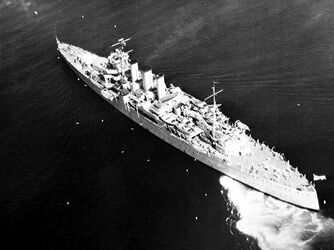
Design and development
The 10,000-ton treaty cruisers were the first type of warships built to internationally agreed restrictions. These restrictions posed new engineering challenges and forced compromises upon designers in how to extract the best balance of speed, armament and protection.
The Royal Navy had a requirement for a vessel for colonial trade route defence, which required a good cruising range and speed and independent fighting power. This determined the need for a long hull and the use of four twin-gun turrets, with any remaining displacement invested in protection. Their high freeboard allowed for spacious decks giving them good seakeeping qualities and living standards for the period.
The long (630 feet overall) hull was flush decked and with a high freeboard and was strongly built. This afforded high initial stability, which contributed to the protection scheme. The machinery spaces followed the traditional layout of boiler rooms ahead of engine rooms, separated by an amidships magazine.
The County class featured a new design of forward superstructure incorporating the navigating bridge, wheelhouse, signalling and compass platforms and gunnery director in a block. This advance considerably rationalised the separate armoured conning tower and myriad of decks and platforms of older designs. Moving the fire-control equipment from the mast negated the need for a heavy tripod and light pole masts sufficed for signalling yards and the spread of wireless antennae.
Armament
The County class carried eight BL 8-inch (203 mm) Mark VIII guns, in superfiring twin turrets fore and aft. The original requirements stated that they should be capable of anti-aircraft fire and were thus provided with a maximum elevation of 70°. In reality the turrets lacked the ability to train and elevate sufficiently quickly to track aerial target and were further hampered by the fire control system being unsuited to the task.
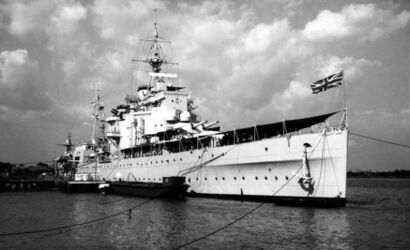
The secondary armament consisted of four QF 4-inch (102 mm) Mark V guns in high angle single mounts. The single 4-inch Mk V guns were later replaced by Mk XVI guns in paired mountings. Torpedo armament was a quadruple-tube torpedo launcher on each side. The initial design called for two octuple mountings for the 40 mm QF 2-pounder Mk.VIII anti-aircraft autocannon but as a weight-saving exercise these were not initially shipped and the existing QF 2-pounder Mark II was carried in lieu on four single mounts. Space was provided for a rotating catapult and a crane for operating aircraft, although again these were initially not provided.
Protection
The initial design left little weight to distribute amongst protection. Thus, the traditional side-belt of armour was dispensed with and the 1-inch (25 mm) side plating was sufficient to only give protection against shell splinters. A 1.25-inch (32 mm) protective deck covered the machinery spaces and there were "box citadels" protecting the magazines and shell rooms; 2.5-inch (64 mm) crowns and 4-inch (102 mm) sides, closed by 2.5-inch bulkheads. The aft box citadel had slightly reduced thicknesses at the ends and the citadel amidships had thinner armour as it lay within the confines of the armoured deck and side plating. There was a 1.5-inch (38 mm) arch over the steering gear closed by a 1-inch-thick forward bulkhead.
Ships of the class
| Name | Class | Builder | Laid down | Launched | Commissioned | Fate |
|---|---|---|---|---|---|---|
| Berwick | Kent | Vickers Armstrongs, Newcastle upon Tyne | 15 Sep 1924 | 30 Mar 1926 | 15 Feb 1928 | Broken up at Blyth, 1948 |
| Cumberland | Vickers-Armstrongs, Barrow in Furness | 18 Oct 1924 | 16 Mar 1926 | 21 Jan 1928 | Broken up at Newport, 1959 | |
| Suffolk | HM Dockyard Portsmouth | 30 Sep 1924 | 16 Feb 1926 | 31 May 1928 | Broken up at Newport, 1948 | |
| Kent | HM Dockyard Chatham | 15 Nov 1924 | 16 Mar 1926 | 22 Jun 1928 | Broken up at Troon, 1948 | |
| Cornwall | HM Dockyard Devonport | 9 Oct 1924 | 11 Mar 1926 | 10 May 1928 | Sunk by Japanese aircraft in "Easter Sunday Raid" south of Ceylon, 5 Apr 1942 | |
| Australia | John Brown & Company, Clydebank | 9 Jun 1925 | 17 Mar 1927 | 24 Apr 1928 | Broken up at Barrow-in-Furness, 1955 | |
| Canberra | 9 Sep 1925 | 31 May 1927 | 10 Jul 1928 | Crippled by Japanese gunfire at Battle of Savo Island 9 Aug 1942; subsequently abandoned and scuttled | ||
London 
|
London | HM Dockyard, Portsmouth | 23 Feb 1926 | 14 Sep 1927 | 31 Jan 1929 | Broken up at Barrow-in-Furness, 1950 |
| Devonshire
|
HM Dockyard, Devonport | 16 Mar 1926 | 22 Oct 1927 | 18 Mar 1929 | Broken up at Newport, 1954 | |
| Sussex | Hawthorn Leslie & Company, Hebburn | 1 Feb 1927 | 22 Feb 1928 | 19 Mar 1929 | Broken up at Dalmuir, 1950 | |
| Shropshire | William Beardmore & Company, Dalmuir | 24 Feb 1927 | 5 Jul 1928 | 12 Sep 1929 | Transferred to RAN 1943
Broken up at Troon, 1954 | |
| Norfolk | Norfolk | Fairfield Shipbuilding & Engineering Company, Govan | 8 Jul 1927 | 12 Dec 1928 | 1 May 1930 | Broken up at Newport, 1950 |
| Dorsetshire | HM Dockyard, Portsmouth | 21 Sep 1927 | 24 Jan 1929 | 30 Sep 1930 | Sunk by Japanese aircraft in "Easter Sunday Raid" south of Ceylon, 5 Apr 1942 |
