User:SirDixie:eu/testing8
Contents
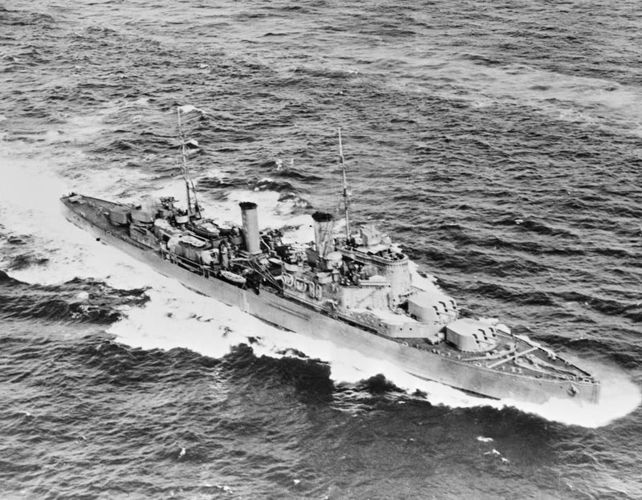
HMS Fiji, 1940
Construction
- Builder: John Brown Shipbuilding Firm;
Clydebank, Scotland, United Kingdom - Laid down: 30 March 1938
- Launched: 31 May 1939
- Commissioned: 5 May 1940
Specifications
- 8,530 tons displacement, standard
- 10,450 tons displacement, full load
- 169.31m length
- 18.90m beam
- 6.04m draft
Machinery
- 4 Admiralty 3-drum boilers,
- 4 Parsons steam geared turbines
Performance
- 31.5 knots at 72,500 shaft horsepower
- 6,520nm at 13 knots
Armor
- Main belt: 83-89mm
- Decks: 51mm
- Turrets: 25.4-51mm
- Barbettes: 25mm
Armament
Main
- Twelve (4x3) 152mm/50 BL Mk.XXIII guns
Secondary
- Eight (4x2) 102mm/45 QF Mk.XVI guns
Anti-Aircraft
- Eight (2x4) 40mm/39 QF Mk.VIII guns
- Eight (2x4) 12.7mm/62 MG Mk.III guns
Torpedoes
- Six (2x3) 533mm torpedo tubes
Aicraft
- One (1) catapult
- Two (2) aircraft (Supermarine Walrus,
Fairey Swordfish or Fairey Seafox)
History
Design
HMS Fiji was a Crown Colony-class light cruiser of the Royal Navy, named after the Pacific island group; the Crown colony of Fiji. She has been the only ship of the Royal Navy to bear the name.
The Crown Colony-class was designed in the aftermath of the Second London Naval treaty, where the size limit for cruisers was reduced from 10,000 tons to 8,000 tons. As a result, the Crown Colony-class made an attempt to keep the same armament of twelve 152mm (6-inch) guns as the previous Town-class cruisers, but on a smaller hull. To achieve this, the hull was shortened by 10 meters from the Southampton sub-class of the Towns, and the armor belt thickness was reduced to 3.5-inches (89mm), although the belt was now extended to cover the machinery spaces, as was used the Edinburgh sub-class of the Town class. Another feature inherited from the previous Edinburgh’s was the Mk.XXIII turret for the 152mm Mk.XXIII gun, featuring the squared off edges on the face of the turret. However, the armor of the turrets was reduced from 114mm on the face to 51mm (2-inches) and from 51mm to 25.4mm (1-inch) on the rest of the turret. This saved 21 tons over the turrets used on Edinburgh. The power of the machinery was also reduced to 72,500 shaft horsepower to save weight, thus reducing the ships top speed to 31.5 knots, as compared to 32.25 knots in the later Town sub-classes.
Other features of the Crown Colony-class that differed from the Town-class was the use of straight funnels and masts, as opposed to the raked ones found on the Town-class, and the use of a transom stern. The after fire control position was mounted on the top of X-turret, as the more conventional position was found to be untenable when the after turrets fired towards the forward limits of their arcs. As a result of the armament on such a small hull, the ships proved very cramped and overcrowded in wartime conditions.
Service
HMS Fiji was commissioned on 5 May 1940, and was assigned to the Home Fleet where she participated in the blockade of German-controlled Europe and escorted convoys. She was due to take part in Operation Menace, the attack on Dakar, but she was hit by a torpedo from submarine U-32, which necessitated 6 months of repairs. In early 1941, after patrolling the Denmark Strait for the German raider Admiral Scheer, she was transferred to Force H, this time operating off the west coast of France as well as performing convoy escort duties on the Malta route. In May 1941, during the battle and evacuation of Crete, Fiji was tasked with covering the rescue of survivors from the destroyer HMS Greyhound, along with 2 other destroyers and the Town-class HMS Gloucester. However, low on anti-aircraft ammunition, the ships were attacked, and Fiji sustained 4 bomb hits, which slowed her and eventually caused her to capsize on 22 May 1941. 523 survivors were picked up.
