Omaha
| <span title="<value_unset_error>" class="commentDrop" height="22">[[File:<value_unset_error>_icon_small.png|link=]]</span> | ||||||
Purchase price1,200,000 
|
| Hit Points23,100 |
| IDS_PAGM091_6IN53_MK13_SINGLE8 х 1 / 2 х 2 pcs. |
| Rate of Fire7.5 shots/min. |
| Reload Time8 sec. |
| Rotation Speed8 deg./sec. |
| 180 Degree Turn Time22.5 sec. |
| Firing Range13.83 km. |
| HE ShellIDS_PAPA030_SHELL_152MM_HE_HC_MARK_34_MOD_1 |
| Maximum HE Shell Damage2,200 |
| Chance of Fire on Target Caused by HE Shell12 % |
| Initial HE Shell Velocity914 m./s. |
| HE Shell Weight47.7 kg. |
| AP ShellIDS_PAPA061_SHELL_152MM_AP_SC_MK_27_MOD_5 |
| Maximum AP Shell Damage3,100 |
| Initial AP Shell Velocity914 m./s. |
| AP Shell Weight47.6 kg. |
| IDS_PAGT042_21IN_TORPEDO_TUBES_TRIPLE4 х 3 pcs. |
| Rate of Fire0.91 shots/min. |
| Reload Time66 sec. |
| Rotation Speed25 deg./sec. |
| 180 Degree Turn Time7.2 sec. |
| TorpedoIDS_PAPT009_MK_11 |
| Maximum Damage11,733 |
| Torpedo Speed56 knot |
| Torpedo Range5.49 km. |
| IDS_PAGA013_1IN_MK2_MOD28 х 4 pcs. |
| . . . Average Damage per Second18.4 |
| . . . Firing Range2.4 km. |
| IDS_PAGA055_BROWNING_M2_MOD24 х 1 pcs. |
| . . . Average Damage per Second15.2 |
| . . . Firing Range1.2 km. |
| Maximum Speed34 knot |
| Turning Circle Radius600 m. |
| Rudder Shift Time7.5 sec. |
| Surface Detectability Range13.09 km. |
| Air Detectability Range5.36 km. |
| <span title="<value_unset_error>" class="commentDrop" height="22">[[File:<value_unset_error>_icon_small.png|link=]]</span> | ||||||
| Purchase price1,200,000
|
| Hit Points26,800 |
| IDS_PAGM091_6IN53_MK13_SINGLE8 х 1 / 2 х 2 pcs. |
| Rate of Fire8.57 shots/min. |
| Reload Time7 sec. |
| Rotation Speed7.5 deg./sec. |
| 180 Degree Turn Time24 sec. |
| Firing Range15.21 km. |
| HE ShellIDS_PAPA030_SHELL_152MM_HE_HC_MARK_34_MOD_1 |
| Maximum HE Shell Damage2,200 |
| Chance of Fire on Target Caused by HE Shell12 % |
| Initial HE Shell Velocity914 m./s. |
| HE Shell Weight47.7 kg. |
| AP ShellIDS_PAPA061_SHELL_152MM_AP_SC_MK_27_MOD_5 |
| Maximum AP Shell Damage3,100 |
| Initial AP Shell Velocity914 m./s. |
| AP Shell Weight47.6 kg. |
| IDS_PAGT042_21IN_TORPEDO_TUBES_TRIPLE4 х 3 pcs. |
| Rate of Fire0.91 shots/min. |
| Reload Time66 sec. |
| Rotation Speed25 deg./sec. |
| 180 Degree Turn Time7.2 sec. |
| TorpedoIDS_PAPT009_MK_11 |
| Maximum Damage11,733 |
| Torpedo Speed56 knot |
| Torpedo Range5.49 km. |
| IDS_PAGA016_3IN50_MK22_MOD26 х 1 pcs. |
| . . . Average Damage per Second16.8 |
| . . . Firing Range3.51 km. |
| IDS_PAGA003_20MM_OERLIKON_MK410 х 1 pcs. |
| . . . Average Damage per Second36 |
| . . . Firing Range2.01 km. |
| IDS_PAGA002_40MM_BOFORS_MK12 х 2 pcs. |
| . . . Average Damage per Second22.6 |
| . . . Firing Range3.51 km. |
| Maximum Speed34 knot |
| Turning Circle Radius600 m. |
| Rudder Shift Time5.7 sec. |
| Surface Detectability Range13.09 km. |
| Air Detectability Range5.36 km. |
[[Ship:<value_unset_error>|<value_unset_error>]] — N/A Tier submarine.
IDS_PASC005_descr
Modules
Compatible Upgrades
Player Opinion
Performance
Refer to the in-game Port screens for more useful data.
The Ship
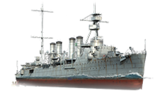
Tier V Omaha is an evolution of Phoenix. A mix of turret and casemate mounted guns means she has plenty of weapons, although she cannot bring them all to bear against an opponent. Among many players, she has a (somewhat deserved) reputation for exploding. But in the right hands, she is capable of unleashing a rain of fire on the enemy team.
Omaha has a small 600 meter turning circle and a fairly quick 6.4 second rudder shift, making her maneuverable which can help her avoid incoming attacks. Her 34 knot top speed is fairly typical for a Tier V cruiser, placing her firmly in the middle of the pack. Unfortunately, her concealment is rather poor at 13.2 km. This can be reduced to 11.8 km with the Concealment Expert skill, but Omaha is unlikely to sneak up on anything smaller than a battleship.
Omaha mounts a standard cruiser Damage Control Party  which is active for 5 seconds with a 60 second cool down between uses. She also carries a Hydroacoustic Search
  and Catapult Fighter
  . Her Hydroacoustic Search is active for 100 seconds with a 120 second cooldown between uses and has 3 uses as standard. When it is active, Omaha will detect enemy ships at 4 km, torpedoes at 3 km, and fully submerged submarines at 2 km. Her Fighter launches a pair of aircraft which will circle around the ship for 60 seconds, providing emotional support to the player. Occasionally, they will intercept an attack and shoot down two attacking aircraft.
Survivability
Even for a Tier V cruiser, Omaha has a reputation for easily exploding. Her citadel is a large and tempting target as it rises a considerable distance above the waterline. Shells aimed between her funnels are likely to hit the citadel, which is protected by a rather thin 76 mm of armor. A broadside Omaha is likely to attract a lot of incoming fire.
Most of her plating is 13 mm thick, which means anything larger than light cruiser guns can overmatch her armor. Omaha can receive citadel hits from almost any angle. Her plating will also be penetrated by all HE shells.
Her health pool is good for a Tier V cruiser, but her weak armor and large citadel considerably reduce the benefits of this. Under sustained fire, Omaha is likely to melt away — or explode – leading to a rapid return to port. With no way to recover lost health or easily disengage from combat, any mistakes can be costly.
Armament
Where Omaha shines is her main battery DPM. She has a large main battery, coupled with one of the fastest reloads at her tier. Omaha can bring up to eight guns to bear on a single target, overwhelming it with a rain of shells. Her 15.2 km range is fairly good for her tier and allows players to maintain some distance from their intended targets. Like most light cruisers, her shells will tend to float as ranges increase which makes targeting maneuvering ships difficult. However, it does allow her to take advantage of island cover to safely engage targets.
Omaha can be a good fire starter, able to set up to 12 fires per minute in ideal circumstances. 25 mm of HE penetration means that her shells will penetrate the decks or superstructures of most ships, even when downtiered. Her AP is somewhat disappointing; past 10 km, Omaha can struggle to penetrate broadside cruisers.
Omaha mounts a pair of triple torpedo launchers on each side, positioned near the stern. Her torpedoes lack the reach or speed to be used safely. Their 5.5 km range means approaching a target to use these weapons will likely result in receiving catastrophic damage in return. These should be thought of as weapons of last resort; if an Omaha is in position to use her torpedoes then at least one player has made a mistake in their positioning.
Anti-Aircraft
Omaha’s stock AA is woeful, with a short range of 2.4 km that will not deter any attacks. Her upgraded hull gives her much improved AA defenses, with a medium range aura reaching out to 3.5 km and her short range guns will roughly double their DPS. They won’t stop a determined attack, but players can hope to bring down some aircraft. Her fighter is also there, and it might do something on occasion.
Anti-Submarine
Omaha carries an ASW airstrike with a 5 km range, potentially allowing her to engage submarines with a degree of safety. The airstrike has a 20 second reload between attacks, limiting the amount of damage that players can cause to a submarine. Her Hydroacoustic Search can aid in submarine hunting, but the short range means that players will need to know where to start hunting.
Battle Performance
Omaha is somewhat of a glass cannon — although she can put a lot of shells downrange, her large citadel and thin armor leaves her vulnerable to return fire. The temptation to use her DPM can lead inexperienced players to overextend or show too much broadside. Turning at the wrong moment can result in an early return to port. This is particularly true when Omaha is downtiered and her enemies become more accurate.
Players should utilize island cover whenever possible to shield themselves from return fire. If nearby cover is not available, players should use their range to engage distracted targets. In open water combat, Omaha should make frequent course changes to present a more difficult target. With practice, it is possible to use throttle and rudder changes to avoid long range salvos aimed at her.
HE shells will be the usual ammunition of choice. Omaha can pose a serious annoyance to battleships, as her rate of fire can tax Damage Control Parties and set multiple fires. Despite its lower penetration, at short ranges her AP can punch through cruiser armor and swing a fight in her favor.Pros:
- High main battery DPM
- Good fire starting potential
- Able to bring multiple guns to bear in any direction
- Decent maneuverability
- Battles are often short
Cons:
- Large, exposed citadel
- Relatively weak AP shells
- Short range torpedoes
- Short AA range
- Battle are often short
Research
Optimal Configuration
Upgrades
- Slot 1: [[Ship:Upgrades#Main_Armaments_Modification.C2.A01|]]
 keeps the guns active and firing.
- Slot 2: [[Ship:Upgrades#Engine_Room_Protection|]]
 keeps the engines and steering working.
- Slot 3: [[Ship:Upgrades#Aiming_Systems_Modification.C2.A01|]]
 improves accuracy and generates more main battery hits.
Commander Skills
Recommended Commander Skills 
| ||||||
|---|---|---|---|---|---|---|
| Cost (points) |
Attack | Defense | ||||
| 1 |
 Grease the Gears
|
 Swift Fish
|
 '
|
 Gun Feeder ★ |
 Incoming Fire Alert ★★ |
 Last Stand ★★★ |
| 2 |
 Demolition Expert ★★ |
 Fill the Tubes
|
 Consumables Enhancements ★★ |
 Eye in the Sky
|
 Priority Target ★★★ |
 Focus Fire Training
|
| 3 |
 Heavy HE and SAP Shells
|
 Pack a Punch
|
 Adrenaline Rush ★★ |
 Heavy AP Shells
|
 Superintendent ★ |
 Survivability Expert ★★★ |
| 4 |
 Top Grade Gunner
|
 Outnumbered
|
 Radio Location
|
 Inertial Fuse for HE Shells ★★ |
 Concealment Expert ★★★ |
 AAA & ASW Expert
|
| Key: ★★★ - Extremely Useful ★★ - Frequently Useful ★ - Occasionally Useful No stars - Not Useful | ||||||

Consumables
Omaha equips the following
- Slot 1: Damage Control Party
- Slot 2: Hydroacoustic Search
- Slot 3: Catapult Fighter
Signals
Recommended Signal Flags 
| |||||
|---|---|---|---|---|---|
| Combat | |||||
 Charlie Kilo
|
 Juliet Yankee Bissotwo
|
 India Yankee
|
 Hotel Yankee
|
 Victor Lima ★★★ |
 India X-Ray ★★★ |
 Juliet Whiskey Unaone
|
 Mike Yankee Soxisix
|
 November Echo Setteseven ★ |
 Sierra Mike ★ |
 November Foxtrot ★ |
 India Delta
|
 X-Ray Papa Unaone
|
 Sierra Bravo
| ||||


Gallery
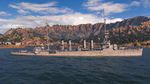
Hull A
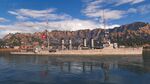
Hull B(best)
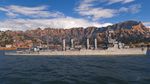
Hull C(removed from game)


Historical Info
USS <value_unset_error>, 1925
Construction
- Todd Dry Dock, Los Angeles, United States
- Laid down: 6 December 1918
- Launched: 14 December 1920
- Commissioned: 24 February 1923
Specifications
- 7,050 tons displacement, standard
- 169.3m length
- 16.85m beam
- 4.11m draft
Machinery
- 12 boilers, 4 turbines
Performance
- 34 knots at 90,000 shaft horsepower
- 8,460nm at 10 knots
Armor
- Main belt: 76.2mm
- Decks: 38.1mm
- Bulkheads: 38.1mm forward, 76.2mm aft
Armament
Main
- Twelve (2x2, 8x1) 152mm guns
Anti-aircraft
- Two (2x1) 76.2mm guns
Torpedoes
- Six (2x3) 533mm torpedo tubes
History
Design
The Omaha-class cruisers were a class of light cruisers built for the United States Navy. The oldest class of cruiser still in service with the Navy at the outbreak of World War II, the Omaha class was an immediate post-World War I design.
Maneuvers conducted in January 1915 made it clear that the US Atlantic Fleet lacked the fast cruisers necessary to provide information on the enemy's position and to deny the enemy information of the fleet's own position and to screen friendly forces. Built to scout for a fleet of battleships, the Omaha class featured high speed (35 knots) for cooperation with destroyers, and 6-inch (152 mm) guns to fend off any destroyers the enemy might send against them. Displacing 7,050 tons, they were just over 555 feet long.
The Omaha class was designed specifically in response to the British Centaur subclass of the C-class cruiser. Although from a modern viewpoint, a conflict between the US and Great Britain seems implausible, US Navy planners during this time and up to the mid-1930s considered Britain to be a formidable rival for power in the Atlantic, and the possibility of armed conflict between the two countries plausible enough to merit appropriate planning measures.
The Omaha class mounted four smokestacks, a look remarkably similar to the Clemson-class destroyers (a camouflage scheme was devised to enhance the resemblance). Their armament showed the slow change from casemate-mounted weapons to turret-mounted guns. They held a full twelve 6-inch/53 caliber guns, of which four were mounted in two twin turrets, one fore and one aft, and the remaining eight in casemates; four on each side. Launched in 1920, Omaha (designated C-4 and later CL-4) had a displacement of just over 7,100 long tons. The cruisers emerged with a distinctly old-fashioned appearance owing to their World War I-type stacked twin casemate-mount cannons and were among the last broadside cruisers designed anywhere.
As a result of the design changes placed on the ship mid-construction, the Omaha that entered the water in 1920 was a badly overloaded design that, even at the beginning, had been rather tight. The ships were insufficiently insulated, too hot in the tropics and too cold in the north. Sacrifices in weight savings in the name of increased speed led to severe compromise in the habitability of the ship. While described as a good ship in a seaway, the low freeboard led to frequent water ingestion over the bow and in the torpedo compartments and lower aft casements. The lightly built hulls leaked, so that sustained high-speed steaming contaminated the oil tanks with sea water.
These drawbacks notwithstanding, the US Navy took some pride in the Omaha class. They featured improved compartmentalization; propulsion machinery was laid out on the unit system, with alternating groups of boiler rooms and engine rooms, to prevent immobilization by a single torpedo hit. Magazines were the first to be placed on centerline, below the waterline. A serious flaw in these ships' subdivision was the complete lack of watertight bulkheads anywhere above the main deck or aft on the main deck.
Originally designed to serve as a scout, they served throughout the interwar period as leaders of fleet flotillas, helping them resist enemy destroyer attack. Tactical scouting became the province of cruiser aircraft, and the distant scouting role was taken over by the new heavy cruisers spawned by the Washington Naval Treaty. Thus, the Omaha class never performed their designed function. They were relegated to the fleet-screening role, where their high speed and great volume of fire were most appreciated.
Due to the large topweight lasting on these ships, compounded by the high-mounted catapults, the Navy removed the two lower aft firing casemate-mounted 6-inch guns in 1939, fairing over the casemates port and starboard.
Service
These were the oldest class of cruisers still in service with the Navy in 1941. All were modified during the war with additional 20mm and 40mm anti aircraft guns and radar.
Both USS Detroit and USS Raleigh were at Pearl Harbor during the attack, with Raleigh being torpedoed. Detroit and USS Phoenix were the only large ships to get out of the harbor during the attack.
The ships of the Omaha class spent most of the war deployed to secondary theaters and in less vital tasks than those assigned to more recently built cruisers. The Omaha class were sent in places where their significant armament might be useful if called upon, but where their age and limited abilities were less likely to be tested. These secondary destinations included patrols off the East and West coasts of South America, convoy escort in the South Pacific far from the front lines of battle, patrols and shore bombardment along the distant and frigid Aleutians and Kuril Islands chains, and bombardment duty in the invasion of Southern France when naval resistance was expected to be minimal. The most significant action than any of the ships of the class saw during the war was Marblehead’s participation in early war actions around the Dutch East Indies (most notably, the Battle of Makassar Strait), and Richmond’s engagement in the Battle of the Komandorski Islands.
None of the ships were wartime losses. Raleigh’s torpedo damage at Pearl Harbor and Marblehead’s damage at Makassar Straight were the only significant wartime combat damage suffered by the class.
The ships of the class were considered obsolete as the war ended, and were decommissioned and scrapped within seven months of the surrender of Japan (with the exception of Milwaukee, which had been loaned to the Soviet Navy, and was scrapped when returned to US Navy control in 1949).
Historical Inaccuracies
- Omaha’s Measure 33, Design 2F camouflage scheme is missing.
- Hull (B) is fictitious. Omaha-class cruisers carried only two quadruple 1.1-inch (28 mm) anti-aircraft guns, one fore and one aft of the ship.
Historical Gallery
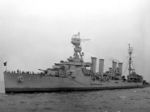
USS Milwaukee (CL-5), an Omaha-class cruiser.
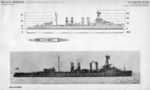
1942 ship recognition chart for the Omaha class.
_1.jpg)

References
Ship Change Log
See here for links to Update notes.
- Added to the game in Update 0.1.6.
- Update 0.2.2.5:
- The AA defense was replaced on the top hull: instead of 350 Mk22, 1Mk2 were installed.
- Update 0.3.:
- Hull C was added.
- Update 0.4.0.4:
- The Hydroacoustic Search consumable was added to the stock hull.
- Update 0.5.0:
- Base firing range increased from 11,500 to 13,465 m.
- Viewing distance increased from 18,390 to 21,080 m.
- The Experience and Credit earnings were reduced by a value in the range of 5-10%.
- Update 0.5.1:
- The number of charges of the "Catapult Fighter I" consumable was reduced to 2 ("Catapult Fighter II" to 3).
- Update 0.5.2:
- Fixed a bug with the torpedo view of the camera.
- Experience earnings increased by 5%.
- Credit earnings increased by 7%.
- Update 0.5.6:
- Decorative air defense installations on the main battery turrets were removed from Hull B, the game characteristics of the ship did not change.
- Update 0.5.8:
- The armor model of the hull was refined.
- Update 0.5.9:
- The thickness of the casemate closest to the bow was increased from 6 to 10 mm.
- Update 0.6.3:
- Base firing range increased to 13,830 m.
- Update 0.6.12:
- Detectability when firing main guns in smoke changed to 6.87 km.
- Update 0.6.13:
- Fire extinguishing time now 30 s instead of 60 s.
- Improved display of thin elements.
- Hull A: Forward compartment HP reduced by 200, service space HP above casemate increased by 100 HP, aft compartment HP reduced by 100 HP, superstructure HP increased by 100 HP
- Hull B: Forward compartment HP reduced by 200, service space HP above casemate increased by 100 HP, aft compartment HP reduced by 100 HP, superstructure HP increased by 100 HP
- Hull C: Forward compartment HP reduced by 200, aft compartment HP reduced by 200 HP, superstructure HP increased by 500 HP
- The survivability of air defense weapons was tested and brought to a single standard. The change affects 76.2 mm and 40 mm guns.
- Update 0.7.10:
- The range of the Hydroacoustic Search consumable was unified - 4 km for detecting ships, 3 km for detecting torpedoes.
- Update 0.8.8:
- Updated silhouette of the ship.
- Update 0.9.2:
- HE shell penetration increased from 24 to 25 mm.
- Central armor reinforced from 13 to 16 mm.
- Update 0.10.3:
- Hulls A and C were removed. Hull B was renamed to Hull A. A new researchable Hull B was created on the basis of the old Hull B with a different air defense composition.
- Update 0.10.11:
- Added the Snow and Stars permanent camouflage.
- Update 0.11.4:
- Fixed an issue with a missing horn sound when using the Snow and Stars permanent camouflage.
- Update 0.11.9:
- Minor fixes to geometry and textures of the ship.
| Destroyers | |
| Cruisers | |
| Battleships | |
| Aircraft Carriers |
- This page was last modified on 3 October 2024, at 19:41.
- This page has been accessed 128,884 times.
© 2011–2026 Wargaming.net. All rights reserved.

