Tachikawa Ki-94-I
Ki-94-I

Totals
| 6800 Price |
| 400 Survivability |
| 7780 kgWeight |
| 1007.5 Damage |
Speed
| 1827.1 Airspeed |
| 700 km/hTop Speed at Sea Level |
| 700 km/hTop Speed at Best Altitude |
| 2000 mOptimum Altitude |
| 850 km/hMaximum Dive Speed |
| 129.8 m/sRate of Climb |
| 180 km/hStall Speed |
| 570 km/hOptimum Airspeed |
Mobility
| 77.8 Controllability |
| 15.4 sAverage Time to Turn 360 deg |
| 80 °/sRate of Roll |
| 888.5 Maneuverability |
Ki-94-I
VII
6800
Tech Tree
Engine
 VII
VII0
EngineMitsubishi Ha-211Ru
| Specifications: | |
| Engine Power, hp | |
| Type | |
| Weight, kg | |
Applicability:Tachikawa Ki-94-I
VIIVII0
Engine
| Specifications: | |
| Engine Power, hp | |
| Type | |
| Weight, kg | |
Applicability:Tachikawa Ki-94-I
VIIAirframe
 VII
VII0
AirframeKi-94-I
| Specifications: | |
| Survivability | |
| Weight, kg | |
Applicability:Tachikawa Ki-94-I
VIIVII0
Airframe
| Specifications: | |
| Survivability | |
| Weight, kg | |
Applicability:Tachikawa Ki-94-I
VIIWing-mounted weapon
 VII
VII0
Machine gun30 mm Ho-155-II (W)
| Specifications: | |
| Caliber | |
| Muzzle Velocity, m/s | |
| Damage | |
| Rate of Fire, rounds/min | |
| Weight, kg | |
Applicability:Tachikawa Ki-94-I
VIIVII0
Machine gun
| Specifications: | |
| Caliber | |
| Muzzle Velocity, m/s | |
| Damage | |
| Rate of Fire, rounds/min | |
| Weight, kg | |
| Price: | |
| Purchase price | |
Applicability:Tachikawa Ki-94-I
VII
Outboard weapon

 VI
VI0
Bombs250 kg
| Specifications: | |
| Damage Radius, m | |
| Damage | |
| Weight, kg | |
| Price: | |
| Purchase price | |
Applicability:Tachikawa Ki-94-I
VIVI0
Bombs
| Specifications: | |
| Damage Radius, m | |
| Damage | |
| Weight, kg | |
| Price: | |
| Purchase price | |
Applicability:Tachikawa Ki-94-I
VIWing-mounted weapon
IX0
Machine gun37 mm Ho-204 (W)
| Specifications: | |
| Caliber | |
| Muzzle Velocity, m/s | |
| Damage | |
| Rate of Fire, rounds/min | |
| Weight, kg | |
Applicability:Tachikawa Ki-94-I
IXIX0
Machine gun
| Specifications: | |
| Caliber | |
| Muzzle Velocity, m/s | |
| Damage | |
| Rate of Fire, rounds/min | |
| Weight, kg | |
| Price: | |
| Purchase price | |
Applicability:Tachikawa Ki-94-I
IX
Modules

Engine
| Tier | Engine | Engine Power, hp / Thrust | Type | Weight, kg | Price, |
|---|---|---|---|---|---|
| VII | Mitsubishi Ha-211Ru | 2200 | air-cooled | 1800 | 136500 |
Airframe
| Tier | Airframe | Survivability | Weight, kg | Price, |
|---|---|---|---|---|
| VII | Ki-94-I | 400 | 5500 | 72500 |
Wing-mounted weapon
| Tier | Machine gun | Caliber | Muzzle Velocity, m/s | Damage | Rate of Fire, rounds/min | Weight, kg | Price, |
|---|---|---|---|---|---|---|---|
| VII | 30 mm Ho-155-II (W) | 30 | 1120 | 160 | 200 | 120 | 65900 |

Outboard weapon
| Tier | Bombs | Damage Radius, m | Damage | Weight, kg | Price, |
|---|---|---|---|---|---|
| VI | 250 kg | 75 | 4400 | 250 | 1200 |
Wing-mounted weapon
| Tier | Machine gun | Caliber | Muzzle Velocity, m/s | Damage | Rate of Fire, rounds/min | Weight, kg | Price, |
|---|---|---|---|---|---|---|---|
| IX | 37 | 1120 | 240 | 120 | 120 | 172000 |
Historical Info
The term Tachikawa Ki-94 refers to two designs of the Tachikawa Hikoki K.K. aircraft factory.
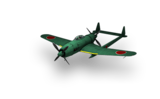
The first was a twin-boom monoplane with two 1,641 kW (2,201 hp) Mitsubishi Ha211 18-cylinder engines, driving two 4-blade propellers in a push-pull configuration. The very heavy armament that should have been mounted on the aircraft (two 37 mm/1.46 in and two 30 mm/1.18 in cannons, should have been enough to make short work of most US heavy bombers of the era. Notwithstanding the outstanding prospective performance, which however was judged as "unduly optimistic" by the technical department of the Japanese Army Air Force, this design was judged too complex by the technical department and the design was discarded.
The first was a twin-boom monoplane with two 1,641 kW (2,201 hp) Mitsubishi Ha211 18-cylinder engines, driving two 4-blade propellers in a push-pull configuration. The very heavy armament that should have been mounted on the aircraft (two 37 mm/1.46 in and two 30 mm/1.18 in cannons, should have been enough to make short work of most US heavy bombers of the era. Notwithstanding the outstanding prospective performance, which however was judged as "unduly optimistic" by the technical department of the Japanese Army Air Force, this design was judged too complex by the technical department and the design was discarded.
Historical Gallery

Japan
| Fighters | IINakajima A4N • IIKawasaki Ki-10 • IIKawasaki Ki-5 • IINakajima Ki-8 • IIIMitsubishi A5M • IIIMitsubishi Ki-18 • IIINakajima Ki-27 • IIIMitsubishi Ki-33 • IVMitsubishi A6M1 Zero • IVNakajima Ki-43-I Hayabusa • VMitsubishi A6M2 Zero • VMitsubishi A6M3 (experimental) • VNakajima Ki-43-II Hayabusa • VIMitsubishi A6M5 Zero • VIKawasaki Ki-61 Hien • VIKawasaki Ki-88 • VIIMitsubishi A7M Reppu • VIINakajima Ki-84 Hayate • VIIIMitsubishi J8M Shusui • VIIITachikawa Ki-94-II • IXTachikawa Ki-162-I • XTachikawa Ki-162-III |
| Heavy Fighters | VKawasaki Ki-45 Toryu • VIKawasaki Ki-102 • VIIRikugun Ki-93 • VIITachikawa Ki-94-I |
| Attack Aircraft |
Heavy Fighters
Premium Planes
Categories:
