Baltimore
| <span title="Baltimore (< 31.05.2018)" class="commentDrop" height="22">[[File:Baltimore (< 31.05.2018)_icon_small.png|link=]]</span> | |||||||||||
Purchase price13 600 000 
|
| Hit Points37 400 |
| 203 mm/55 Mk153 х 3 pcs. |
| Rate of Fire4 shots/min. |
| Reload Time15 sec. |
| Rotation Speed6 deg./sec. |
| 180 Degree Turn Time30 sec. |
| Firing Range14.39 km. |
| Maximum Dispersion132 m. |
| HE Shell203 mm HE/HC Mk25 |
| Maximum HE Shell Damage2800 |
| Chance of Fire on Target Caused by HE Shell14 % |
| Initial HE Shell Velocity823 m./s. |
| HE Shell Weight118 kg. |
| AP Shell203 mm AP Mk19 |
| Maximum AP Shell Damage4600 |
| Initial AP Shell Velocity853 m./s. |
| AP Shell Weight118 kg. |
| 127 mm/38 Mk326 х 2 pcs. |
| Firing Range5 km. |
| Rate of Fire10 shots/min. |
| Reload Time6 sec. |
| HE Shell127 mm HE Mk32 |
| Maximum HE Shell Damage1800 |
| Initial HE Shell Velocity792 m./s. |
| Chance of Fire on Target Caused by HE Shel5 % |
| 127 mm/38 Mk326 х 2 pcs. |
| . . . Average Damage per Second90.6 |
| . . . Firing Range5.01 km. |
| 20 mm Oerlikon Mk423 х 1 pcs. |
| . . . Average Damage per Second82.8 |
| . . . Firing Range2.01 km. |
| 40 mm Bofors Mk112 х 2 pcs. |
| . . . Average Damage per Second135.6 |
| . . . Firing Range3.51 km. |
| Maximum Speed32.5 knot |
| Turning Circle Radius730 m. |
| Rudder Shift Time10.2 sec. |
| Surface Detectability Range12.6 km. |
| Air Detectability Range9.06 km. |
| <span title="Baltimore (< 31.05.2018)" class="commentDrop" height="22">[[File:Baltimore (< 31.05.2018)_icon_small.png|link=]]</span> | |||||||||||
| Purchase price13 600 000
|
| Hit Points42 700 |
| 203 mm/55 Mk153 х 3 pcs. |
| Rate of Fire6 shots/min. |
| Reload Time10 sec. |
| Rotation Speed6 deg./sec. |
| 180 Degree Turn Time30 sec. |
| Firing Range15.83 km. |
| Maximum Dispersion132 m. |
| HE Shell203 mm HE/HC Mk25 |
| Maximum HE Shell Damage2800 |
| Chance of Fire on Target Caused by HE Shell14 % |
| Initial HE Shell Velocity823 m./s. |
| HE Shell Weight118 kg. |
| AP Shell203 mm AP Mk21 |
| Maximum AP Shell Damage5000 |
| Initial AP Shell Velocity762 m./s. |
| AP Shell Weight152 kg. |
| 127 mm/38 Mk326 х 2 pcs. |
| Firing Range5 km. |
| Rate of Fire10 shots/min. |
| Reload Time6 sec. |
| HE Shell127 mm HE Mk32 |
| Maximum HE Shell Damage1800 |
| Initial HE Shell Velocity792 m./s. |
| Chance of Fire on Target Caused by HE Shel5 % |
| 20 mm Oerlikon Mk423 х 1 pcs. |
| . . . Average Damage per Second82.8 |
| . . . Firing Range2.01 km. |
| 40 mm Bofors Mk212 х 4 pcs. |
| . . . Average Damage per Second190.8 |
| . . . Firing Range3.51 km. |
| 127 mm/38 Mk326 х 2 pcs. |
| . . . Average Damage per Second90.6 |
| . . . Firing Range5.01 km. |
| Maximum Speed32.5 knot |
| Turning Circle Radius730 m. |
| Rudder Shift Time7.8 sec. |
| Surface Detectability Range12.6 km. |
| Air Detectability Range9.06 km. |

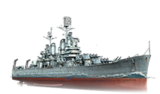
[[Ship:Baltimore (< 31.05.2018)|Baltimore (< 31.05.2018)]] — American Tier IX cruiser.
Este barco estaba disponible antes del lanzamiento de la actualización 0.7.4.
Modules
 |
Rate of Fire (shots/min) | 180 Degree Turn Time (sec) | Maximum Dispersion (m) | Maximum HE Shell Damage (HP) | Chance of Fire on Target Caused by HE Shell (%) | Maximum AP Shell Damage (HP) |
Research price (exp) |
Purchase price ( ) | |
|---|---|---|---|---|---|---|---|---|---|
| 203 mm/55 Mk.15 en una torreta | 4 | 30 | 132 | 2800 | 14 | 4600 | 0 | 1 100 000 | |
| 203 mm/55 Mk.15 en una torreta | 4 | 30 | 132 | 2800 | 14 | 4600 | 27 500 | 2 400 000 |
 |
Hit Points (HP) | Armor (mm) | Armor (mm) | Main Turrets (pcs.) | Secondary Gun Turrets (pcs.) | AA Mounts (pcs.) | Torpedo Tubes (pcs.) | Hangar Capacity (pcs.) |
Research price (exp) |
Purchase price ( ) | |
|---|---|---|---|---|---|---|---|---|---|---|---|
| Baltimore (A) | 37 400 | 6 | 203 | 3 | 6 | 23/12/6 | 0 | 1 450 000 | |||
| Baltimore (B) | 42 700 | 6 | 203 | 3 | 6 | 23/12/6 | 40 500 | 3 020 000 |
 |
Firing Range Increase (%) | Maximum Firing Range (km) |
Research price (exp) |
Purchase price ( ) | |
|---|---|---|---|---|---|
| Mk9 mod. 1 | 0 | 0 | 985 000 | ||
| Mk9 mod. 2 | 0 | 24 000 | 2 000 000 |
 |
Maximum Speed (knot) |
Research price (exp) |
Purchase price ( ) | |
|---|---|---|---|---|
| Propulsión: 120 000 CV | 32,5 | 0 | 875 000 |
Compatible Upgrades
| Slot 2 |

|
|---|
Player Opinion
Performance
Amusingly called the "Baltimoist", "BaltiMOAR" and "tier 9 CIWS", the Baltimore is the first shift of the 'modern' heavy cruiser within the United States Navy. While New Orleans was the beginning of that iteration, Baltimore and later her successors Oregon City and the vaunted Des Moines came to be using her design. In most cases, Baltimore is a good all rounder cruiser with decent concealment, good set of guns and ergonomics that may feel a bit 'sticky' in first handling in her stock configs, but once you fully kit the heavy cruiser, she can be something to be a force to ponder. While she does not have the broadside weight of her Japanese counterpart Ibuki or the unique A-XY layout and load time of her German counterpart Roon or even the stocky guns of her Russian counterpart Dmitri Donskoi, she does have her merits understood into one single quote: "you can throw predicaments against a Baltimore but you can never throw off her adaptability". Her guns are very reasonable for her load time which can be lessened at the cost of turret traverse speed and she can surprisingly take a beating unlike her peers, and most of all, while she does not have torpedoes unlike her colleagues, she makes up for it with her borderline absurd AA suite which is enough for aircraft screening duties whenever ships that do not possess a good AA suite are not present in the lineup.
While not on the level of Des Moines in anti-surface capability, the Baltimore proves herself with her heavy AP shells which her successor also uses that can deal damage even against bigger targets like a battleship as well as deal severe damage to her peers and her HE is decent enough to cause problems to the receiving end, although it requires shelling the target more often in order to achieve good results. Adding to the fact that Baltimore has the radar scanner consumable which she can perform destroyer screens with more lethality. When in combat, remember the quote mentioned as the Baltimore neither has an edge nor is deficit in the hands of a skilled player.
It is something to note, however, that Baltimore can choose between two guns at her disposal: the stock guns which have better shell speed at the cost of typical cruiser reload time of 15 seconds at her tier or the upgraded guns which load faster and fires the same AP shell Des Moines uses at the cost of reduced shell speed.
As of the current iteration, Baltimore received a reload buff which gives her top guns an astounding 10 seconds of load time which enables her to be a pummeling fire support as needed.Pros:
- very powerful AA suite if kitted as an AA cruiser
- can mount the plotting room equipment should the top 15.8km range not suffice
- surprising AP shells
- effective jack of all trades
- Very friendly ergonomics
- same concealment rating as her colleague Ibuki
- Decent HE shells
- reasonable load time
- Can choose between guns that are oriented to accurately beading fast ships or guns that deal heavier damage at the cost of shell speed
Cons:
- shell arc and speed on top guns leave much to be desired
- turret traverse is slightly slow
- AP shells will ONLY be devastating if the cruiser gets close enough
- durability is questionable
- stock grind will be a sizable bump in the road
Research
What you should research depends on how you want to play.
- If you liked the style of New Orleans at Tier 8, then you should research the Gun Fire Control System first, saving the new guns for last. Keep in mind, however, that this will not train you to use the guns on Des Moines well
- If you want to unlock the full DPM and AP penetration potential of this ship, it is highly recommended to rush the upgraded guns. This will not only train you in how to use the Des Moines' guns later in the tree, it also turns what was an uptiered New Orleans into a DPM monster.
Optimal Configuration
Commander Skills
Recommended Commander Skills 
| ||||||||
|---|---|---|---|---|---|---|---|---|
| Cost (points) |
Endurance | Attack | Support | Versatility | ||||
| 1 |
 Priority Target ★★★ |
 Preventative Maintenance ★★ |
 Expert Loader ★ |
 Aircraft Servicing Expert
|
 Direction Center for Catapult Aircraft ★ |
 Dogfighting Expert
|
 Incoming Fire Alert ★★ |
 Evasive Maneuver
|
| 2 |
 High Alert ★ |
 Jack of All Trades ★★ |
 Expert Marksman ★★★ |
 Torpedo Acceleration
|
 Smoke Screen Expert
|
 Expert Rear Gunner
|
 Adrenaline Rush ★★ |
 Last Stand
|
| 3 |
 Basics of Survivability ★ |
 Survivability Expert ★ |
 Torpedo Armament Expertise
|
 Emergency Takeoff
|
 Basic Firing Training ★★ |
 Superintendent ★★★ |
 Demolition Expert ★★★ |
 Vigilance ★★ |
| 4 |
 Manual Fire Control for Secondary Armament
|
 Fire Prevention ★ |
 Inertia Fuse for HE Shells
|
 Air Supremacy
|
 Advanced Firing Training ★★★ |
 Manual Fire Control for AA Armament ★★ |
 Radio Position Finding ★★ |
 Concealment Expert ★★★ |
| Key: ★★★ - Extremely Useful ★★ - Frequently Useful ★ - Occasionally Useful No stars - Not Useful | ||||||||
Gallery
Historical Info
Construction
- Bethlehem Steel, Quincy, United States
- Laid down: 26 May 1941
- Launched: 28 July 1942
- Commissioned: 15 April 1943
Specifications
- 14,472 tons displacement, standard
- 205.26m length
- 21.59m beam
- 7.32m draft
Machinery
- 4 boilers, 4 turbines
Performance
- 33knts at 120,000shp
- 10,000nm at 15knts
Armor
- Main belt: 152mm mid, 76.2mm forward and aft
- Decks: 63.5mm
- Bulkheads: 127-152mm
- Barbettes and Turrets: 160.87mm barbette, 203mm face, 95.25mm side, 76.2mm roof
Armament
Main
- Nine (3x3) 203mm guns
Secondary
- Twelve (6x2) 127mm guns
Anti-aircraft
- Forty-eight (11x4, 2x2) 40mm guns
- Twenty-four (24x1) 20mm guns
History
Design
The USS Baltimore was the lead ship of the Baltimore-class cruisers, which were the only USN cruisers to be built unrestricted by the pre-war Naval Treaties to see service in the US Navy. They were originally designed to be based on the Cleveland-class and USS Wichita, the latter of which was based on the Brooklyn-class. Because construction started in September 1939, treaty limits no longer applied and the new cruiser class could be built significantly larger and better than it was designed to be. As such, they were mounted with a superior array of anti-aircraft power, far better than that of any earlier class. There is also the Oregon City sub-class, which consisted of CA-122 to 124, that has only three distinct differences from the main class - a single crane placed on the center line replaced the two from the original, a single funnel replacing the two original funnels, and a shortened superstructure. Four more Oregon City class cruisers were ordered on 14 June 1943, but were changed into the Des Moines class cruisers before work began.
The first two batches of eight Baltimore-class cruisers were built by Bethlehem Steel, which was the major contractor for the this class of cruisers. In the third batch of 17 cruisers, eight more cruisers were ordered from Bethlehem. They constructed the three Oregon City-class and a prototype fleet flagship, with CA-126 & -127 laid down but never completed, and CA-128-129 never laid down. The last four ordered Baltimore-class cruisers were changed to Des Moines-class cruisers.
Service
The USS Baltimore was commissioned in April 1943 and first saw service with Task Force 52 at the invasion of Makin in the Gilbert Islands, providing artillery support and anti-air screening for the escort carriers. The cruiser would also take part in the invasion of Marshall Islands, raid on Palau Islands, and invasion of Iwo Jima. The main task for the Baltimore was to support and provide anti-air cover for the carriers it was grouped with, such as the Saratoga, Lexington, and Princeton. In July 1944, it became the Presidential flagship and transported Franklin D. Roosevelt to Pearl Harbor, where he met with Admiral Nimitz & General MacArthur. It was only a short while before it would transfer the Presidential party to the USS Cummings and be relieved of its duty as Presidential flagship. The Baltimore returned to its duties as a carrier escort in December 1944.
Historical Gallery
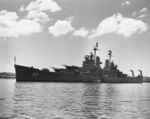
USS Baltimore (CA-68)
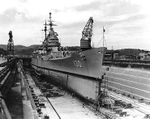
USS Bremerton in drydock
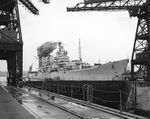
USS Baltimore during her reactivation
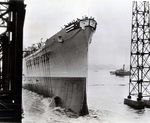
Launching of the USS Baltimore
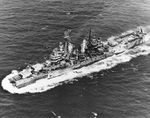
USS Pittsburgh with her bow ripped off
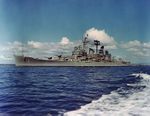
USS Boston, the template for the later Boston-class
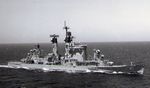
USS Chicago refitted as an Albany-class cruiser
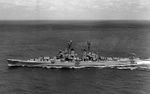
Side-view of Los Angeles
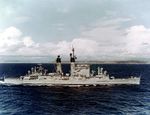
Side-view of Columbus, refitted as an Albany-class cruiser
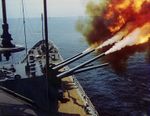
Salvo by both forward turrets on St. Paul during the Vietnam War
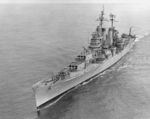
USS Pittsburgh with the SPS-8 on the aft mast, and the SPS-6 on the forward mast
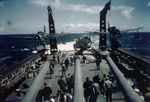
Two Kingfishers on their catapults on board USS Quincy
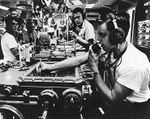
The crew of Canberra plotting target data
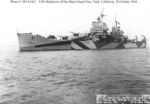
USS Baltimore off Mare Island with camouflage Measure 32, Design 16d
.jpg)
_drydocked.jpeg)
_reactivation.jpeg)

_loss_of_bow.jpeg)

.jpg)
_renders_honor.jpeg)

_Vietnam.jpeg)
_Radar.jpeg)
_Kingfisher.jpeg)
_crew.jpeg)

| Destroyers | II Sampson • II Smith • III Wickes • IV Clemson • IV DD 214 • V Nicholas • V Hill • VI Farragut • VI Monaghan • VII Mahan • VII Sims • VII Hughes • VII Sims B • VIII Benson • VIII Osborne • VIII Kidd • IX Fletcher • IX Christopher • IX Benham • IX Halford • IX Black B • IX Black • IX Johnston • IX GQ Johnny • IX Frank Friday • X Gearing • X Burrows • X Somers • X Forrest Sherman • X Laffey • X Hull • X [[Ship:[Gearing]|[Gearing]]] • Joshua Humphreys • III Wickes • IV Clemson • IV DD 214 • V Nicholas • V Hill • VI Farragut • VI Monaghan • VII Mahan • VII Sims • VII Hughes • VII Sims B • VIII Benson • VIII Osborne • VIII Kidd • IX Fletcher • IX Christopher • IX Benham • IX Halford • IX Black B • IX Black • IX Johnston • IX GQ Johnny • IX Frank Friday • X Gearing • X Burrows • X Somers • X Forrest Sherman • X Laffey • X Hull • X [[Ship:[Gearing]|[Gearing]]] • Joshua Humphreys
|
| Cruisers | I Erie • II Chester • II Albany • III St. Louis • III Charleston • IV Phoenix • V Omaha • V Marblehead • V Marblehead Lima • V Rattlehead • VI [[Ship:Cleveland (< 31.05.2018)|Cleveland (< 31.05.2018)]] • VI Pensacola • VI Dallas • VII Atlanta • VII [[Ship:Pensacola (< 31.05.2018)|Pensacola (< 31.05.2018)]] • VII New Orleans • VII Helena • VII Indianapolis • VII Atlanta B • VII Boise • VII Flint • VIII [[Ship:New Orleans (< 31.05.2018)|New Orleans (< 31.05.2018)]] • VIII Baltimore • VIII Cleveland • VIII Wichita • VIII Anchorage • VIII Congress • VIII Rochester • VIII San Diego • VIII AL Montpelier • VIII Protector • IX [[Ship:Baltimore (< 31.05.2018)|Baltimore (< 31.05.2018)]] • IX Buffalo • IX Seattle • IX Vallejo • IX Alaska • IX Tulsa • IX Alaska B • IX Cambridge • X Des Moines • X Worcester • X Puerto Rico • X Salem • X Austin • Jacksonville • Annapolis
|
| Battleships | III South Carolina • IV Wyoming • IV Arkansas Beta • V New York • V Oklahoma • V Texas • VI New Mexico • VI Arizona • VI W. Virginia '41 • VII Colorado • VII Florida • VII West Virginia '44 • VII California • VII Colorado 2 • VIII North Carolina • VIII Kansas • VIII Nebraska • VIII Alabama • VIII Massachusetts • VIII Alabama VL • VIII Constellation • VIII Massachusetts B • VIII Alabama ST • VIII Tennessee • VIII North Carolina CLR • VIII Alabama B • VIII Volunteer State • VIII North Carolina 2 • IX Iowa • IX Minnesota • IX Delaware • IX Missouri • IX Kearsarge • IX Illinois • IX Kearsarge B • IX Georgia • IX AL Kearsarge • IX Iowa 2 • X Montana • X Vermont • X Louisiana • X Ohio • X Oregon • X Rhode Island • X Wisconsin • X BA Montana • X [[Ship:[Montana]|[Montana]]] • X Montana 2 • X Utah • Maine
|
| Aircraft Carriers | IV [[Ship:Langley (< 23.01.2019)|Langley (< 23.01.2019)]] • IV Langley • V [[Ship:Bogue (< 23.01.2019)|Bogue (< 23.01.2019)]] • VI [[Ship:Independence (< 23.01.2019)|Independence (< 23.01.2019)]] • VI Independence • VI Ranger • VII [[Ship:Ranger (< 23.01.2019)|Ranger (< 23.01.2019)]] • VII [[Ship:Saipan (< 23.01.2019)|Saipan (< 23.01.2019)]] • VIII [[Ship:Lexington (< 23.01.2019)|Lexington (< 23.01.2019)]] • VIII Yorktown • VIII Lexington • VIII [[Ship:Enterprise (< 23.01.2019)|Enterprise (< 23.01.2019)]] • VIII Enterprise • VIII Saipan • VIII Hornet • VIII Saipan B • VIII AL Hornet • IX [[Ship:Essex (< 23.01.2019)|Essex (< 23.01.2019)]] • X [[Ship:Midway (< 23.01.2019)|Midway (< 23.01.2019)]] • X Essex • X Midway • X Franklin D. Roosevelt • X [[Ship:[Midway]|[Midway]]] • United States
|
- Esta página fue modificada por última vez el 24 ago 2017, a las 21:33.
- Esta página se ha visitado 158 veces.
© 2011–2026 Wargaming.net. Todos los derechos reservados.
