United States
1

The United States inherited many of its nascent naval traditions from the British, from whom they won their independence in 1776. Over the years, the fledgling American navy encountered various hurdles and successes in its conflicts with the British, French, and Spanish navies. However, a mix of poor economic outlook, isolationist sentiments and post-World War I[2] naval disarmament treaties reduced the effectiveness and preparedness of the USN for the Second World War. All of that changed after Japan's 7 December 1941 surprise attack on Pacific Fleet headquarters at Pearl Harbor, Hawaii. Regarded as an underhanded sneak attack outside the rules of civilized warfare, Pearl Harbor evaporated any reluctance of the American public to go to war.
With its battleship fleet crippled by the Pearl Harbor attack, the USN turned to submarines and its fledgling aircraft carrier fleet — the very weapons that the IJN had used in their attempt to neutralize the USN Pacific Fleet — and ironically put them to greater effect than the Japanese (who stuck to battleships and the "decisive battle" doctrines), achieving successes in the battles of the Coral Sea, Midway, the Philippine Sea, Leyte Gulf, and Okinawa. While slightly behind their IJN counterparts at the onset of the war, the USN gradually caught up both qualitatively and quantitatively; virtually every class of vessel was outfitted with superior fire control equipment such as radar and ballistics computers; the industrial might of the United States produced large numbers of proven designs (the 175 destroyers of the Fletcher class built within the space of less than four years being a prime example) with little unnecessary variation in equipment, so that crew transferred between ships could quickly fill their roles without specialized retraining. The US Navy emerged from World War II[3] as the most powerful navy in the world, a title it still holds to this day.
Destroyers
Gameplay
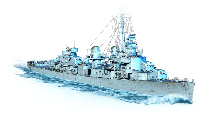
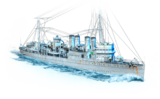
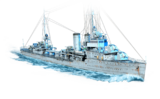
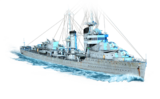
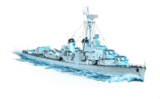
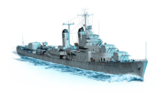
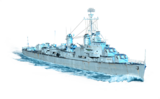
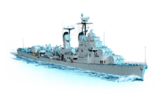
The play style of American destroyers[4] is best summarized as "annoy and harass"; their fast-firing guns in quick-turning turrets can continuously rain fire on opponents with impunity while under cover of smoke or vision blockers such as islands. Legendary Tier Gearing, the crown jewel of USN destroyers, can blanket her targets with more than 120 rounds per minute. Unfortunately, slow shell velocities and incredulously high shell arcs, while allowing captains to fire over islands, make it near-impossible to hit anything but the largest of targets beyond medium ranges. They also have reasonable anti-aircraft firepower, allowing them to play the role of escort ship when the need arises; fire discipline and astute Smoke Generator usage are required, since gun and anti-aircraft battery fire can broadcast a ship's position. American torpedoes had variable speed settings; in World of Warships, only the high-speed setting is available (with the exception of Tier VI premium Sims). In-game, this means that lower tier American destroyers, instead of stealthily launching a spread out of visual range, are forced to weather fire from their targets' primary and secondary batteries well before they come within torpedo range. However, starting with Mahan at Tier V, it is possible to launch a torpedo salvo from beyond detection range, albeit still at shorter ranges than their Japanese counterparts. To put things in perspective, Americans have to wait until their Tier VI's Benson before they get torpedoes with 9km range; the Japanese achieve this range with Tier V destroyers Hatsuharu and Fubuki... and both of them reload faster.
Cruisers
Gameplay
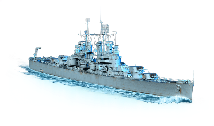
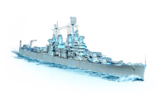
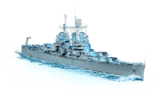
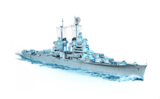
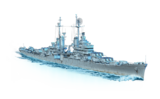
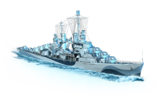
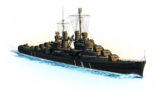
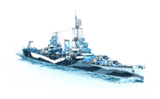
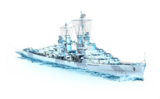
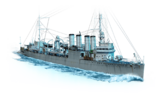
American cruisers[5] are all about the guns; their primary battery, secondary battery, and anti-aircraft armament are superlative. Forgoing torpedoes after Omaha at Tier IV, they are instead able to lay down an incredible hail of gunfire in almost any direction, due to the fast-firing guns located along the sides of their lower-tier ships, or in their fast-turning turrets at higher tiers. Any enemies — especially destroyers — that come within firing range and do not take evasive action are quickly sent to the bottom of the ocean, particularly after the line gains access to the Surveillance Radar  consumable at Tier VII. Although the Japanese often have better range and firepower, the Americans have faster turret traverse, conventional layouts, and higher rates of fire; the high shell arc of some of their cruiser rifles — like their destroyer counterparts — is a double-edged sword, with a plunging trajectory hampered by their unimpressive shell velocities. Their anti-aircraft batteries easily dissuade aircraft from venturing too close or even approaching if they're not massed together for protection; yet even then, a well-timed Defensive AA Fire
 will quickly deplete the assets of enemy aircraft carriers. The American cruiser line splits after Omaha into a heavy cruiser branch - starting with Pensacola and topped by Des Moines - and a light cruiser branch starting with Dallas and topped by Worcester. Des Moines is the very pinnacle of the all-gun cruiser, as she has a very powerful anti-aircraft suite and main batteries that have unrivaled rate of fire. Worcester has rapid-fire guns, many consumables, and a great AA suite, which gives her unparalleled versatility on the battlefield.
Battleships
Gameplay
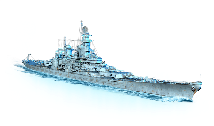
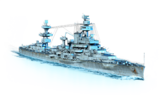
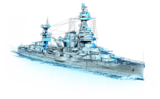
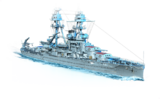
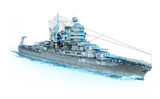
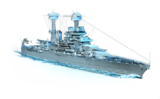
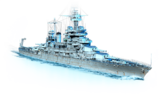
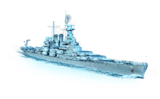
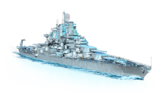
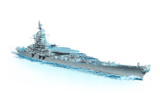
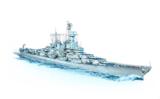
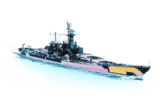
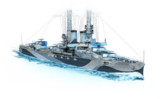
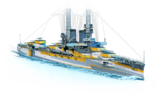
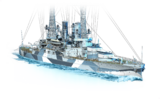
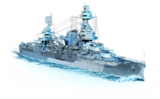
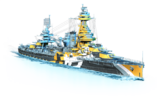
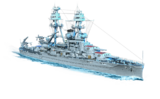
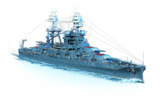
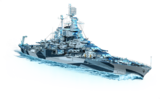
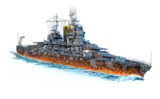
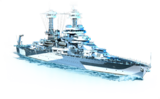
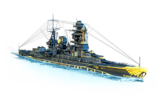
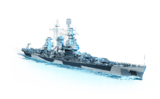
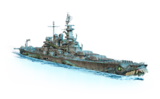
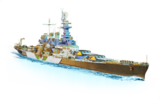
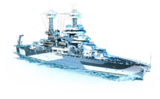
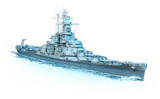
American battleships[6] follow more orthodox and consistent designs: while their guns may not be as large and powerful as those of the IJN, the USN ships make up for it by having more guns that fire more often, giving them unmatched broadside firepower. Their anti-air suites are also fairly decent at staving off aerial assaults, although it's still recommended to have cruiser escort. In spite of inferior firing ranges and poor mobility, American battleships are capable of absorbing major damage in order to bring their guns to bear—their citadel armor is impenetrable to all but the largest caliber shells (at the cost of having a more lightly-armored bow and stern). Moving up the tech tree, players can now choose to continue on with the slow battleship line that begins with Tennessee or they can choose the fast battleship line that begins with New Mexico ,their mobility progressively improves and catches up with the Japanese at Tier VII, and their AA firepower grows to the point that they either become practically immune to all but the most concentrated of air attacks, or the aircraft will not survive the return trip. From Tier III to VII, American battleships enjoy a better Repair Party consumable than other nations, excluding the British, giving the line better durability. Legendary Tier Montana is the pinnacle of the main American battleship line: the evolution of the Iowa-class battleship design whose construction was cancelled some time after receiving congressional approval for construction in order to focus more on aircraft carrier production.
Aircraft Carriers
Gameplay
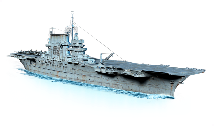
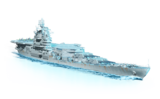
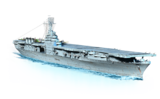
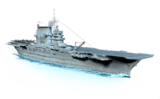
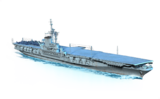
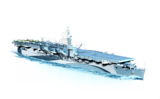
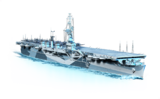
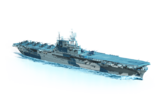
Early in the war, the overall state and quantity of USN naval aviation lagged behind their Japanese rivals. Thus, their early carriers [7] can be painful to use. Their large sizes up-and-down the line mean that they can be seen from miles away, and even though they are quite durable with surprisingly strong anti-aircraft defenses, remaining un-spotted or sticking with teammates for protection is still recommended. The HE bombs are a devastating threat to destroyers and a nuisance to other ship types. Planes have high health pool compared to their IJN counterparts, allowing them to survive longer and keep full squadrons toward the end of the game. However, torpedo bombers carry very slow torpedoes with short range and a large dispersion even when fully aimed. Players are encouraged to drop their payload at close distances.
 Cruisers


Premium


 Destroyers


 Battleships

Premium

 Aircraft Carriers



American Commanders
 Jack of All Trades
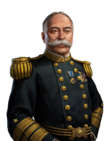
The following commanders have skills and traits which can be utilized across each of the different ship classes however they are not specialized in any particular one.
Cruisers
These commanders have skills that not only suit cruisers, but will sometimes only have an impact on that class of ship. Cruisers type skills often have an emphasis on long range support, HE fire chance and sonar/hydroacoustic search modifiers. Although these commanders are specialized for Cruisers, they can be utilized on any ship class.






Destroyers
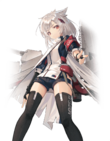
With skills focusing on speed, stealth, torpedoes and smokescreens to name a few examples, the following commanders are best used on your destroyers. Although these commanders are specialized for Destroyers, they can be utilized on any ship class.





Battleships
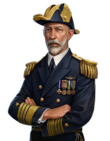
Featuring skills that can improve your secondary batteries, repair consumables, accuracy and armor penetration as just a handful of examples, these commanders are best suited for usage on your battleships. Although these commanders are specialized for Battleships, they can be utilized on any ship class.










Aircraft Carriers
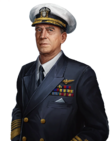
These commanders have skills that focus on aircraft carriers' performance, as well as on their planes' such as their speed, recovery time, bomb and torpedo damage, and more. Although these commanders are specialized for Aircraft Carriers, they can be utilized on any ship class.

References
- ↑ United States Navy (Wikipedia) and History of the United States Navy (Wikipedia) and United States Navy ships (Wikipedia)
- ↑ United States Navy operations during World War I (Wikipedia)
- ↑ United States Navy in World War II (Wikipedia)
- ↑ Destroyers of the United States Navy (Wikipedia)
- ↑ Cruisers of the United States Navy (Wikipedia)
- ↑ Battleships of the United States (Wikipedia)
- ↑ Aircraft carriers of the United States Navy (Wikipedia)

